Adding a tamper-evident lid to a disposable bowl sounds like an easy packaging upgrade. In practice, it changes more than the lid itself. It can affect unit cost, packing speed, carton loading, opening experience, and even the way customers judge the condition of the food.
That is why the right question is not simply whether a disposable bowl can have a tamper-evident lid. The more useful question for a buyer is whether the extra closure feature solves a problem that a standard lid cannot.
For a custom disposable bowl manufacturer, the answer should start with the product's actual handling route rather than the feature list on a catalog page.
Start With the Risk, Not the Lid

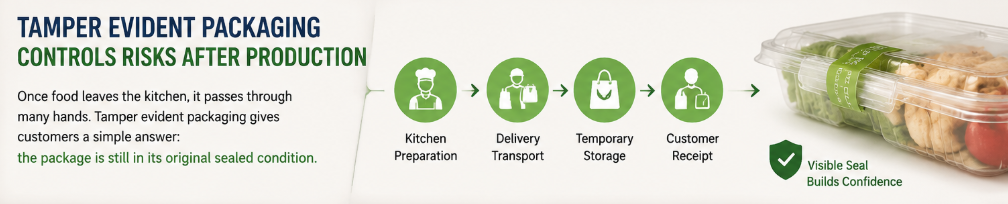
Consider what happens after a bowl is filled and closed. It may move from a kitchen to a storage area, into a delivery bag, through a pickup counter, across a distribution network, or onto a refrigerated shelf before reaching the customer.
Every additional handling point creates a different packaging concern.
If the main problem is that soup leaks during transport, a tamper-evident feature alone does not solve it. If the concern is that a customer cannot tell whether a ready-to-eat meal has already been opened, stronger first-opening evidence becomes much more relevant.
Tamper evidence is therefore about visible package integrity, not simply making the lid harder to remove. A tear strip, breakaway tab, locking edge, or similar structure is useful because opening creates a visible change rather than allowing the package to be opened and returned to an apparently untouched condition.
When a Standard Lid May Already Be Enough

Not every disposable bowl needs an additional security feature.
A restaurant that prepares an order, closes the bowl, and hands it directly to a customer in a controlled environment may have little reason to add a tamper-evident mechanism. The same can apply to back-of-house food preparation where the container is not exposed to customers before consumption.
For a disposable bowl supplier, this distinction matters because adding a more complicated lid to every SKU can increase packaging cost without addressing the buyer's actual operating problem.
A secure snap-fit lid may already provide sufficient retention for some applications. If the buyer's primary concern is keeping the lid attached during short-distance handling, the purchasing decision should focus first on closure fit, stacking, and leakage performance.
When Multiple Hand-Offs Change the Equation
The decision becomes different when the bowl passes through several people before consumption.
Takeaway meals, prepared salads, chilled food, catering portions, and other ready-to-eat products can move through kitchens, pickup counters, drivers, warehouses, or retail environments. In these situations, customers may reasonably want a simple visual indication that the package has not been opened after packing.
This is where OEM disposable bowl packaging can become more than a matter of capacity and material selection. The closure needs to fit the actual sales channel.
Retail products have another consideration: the customer may physically handle the package before purchase. If the tamper-evident feature is difficult to see, covered by a label, or too subtle to understand, its practical value is reduced.
The feature works best when the difference between “intact” and “opened” is obvious without requiring the customer to understand the engineering behind the container.
Tamper-Evident Does Not Mean Leak-Proof
This distinction is easy to miss during procurement.
A tamper-evident lid is designed to show evidence of opening. It is not automatically a leak-proof lid, and a stronger locking mechanism does not necessarily mean better performance with liquid food.
A soup bowl, for example, may need to handle heat, liquid movement, stacking pressure, and repeated transportation shocks. A salad bowl may have different requirements because dressing, condensation, and fresh ingredients create another set of packaging conditions.
For a PP disposable bowl factory, this means the lid and bowl should be evaluated as one packaging system. Closure geometry, rim design, material stiffness, filling level, and actual food weight can all affect the result.
Package integrity testing also needs to match the problem being investigated. ASTM F2096, for example, is a test method for detecting gross leaks by internal pressurization; it addresses leakage rather than serving as a general test for tamper evidence.
Test the Filled Bowl, Not Just the Empty Sample

An empty bowl can make a closure look perfect.
The more useful test is to fill it with the intended product, close it using the actual packing process, stack it as it would be packed for shipment, and then evaluate the closure after handling and storage.
This is especially important for disposable food bowl manufacturers working with wholesale programs. A sample that closes smoothly once does not prove that hundreds of thousands of units will behave identically.
Buyers should pay attention to whether the tamper feature remains intact during normal packing, whether accidental damage occurs during stacking, whether the opening mechanism is understandable to customers, and whether the package can still be handled efficiently by staff.
The opening experience matters too. A security feature that is excessively difficult to remove can turn a useful packaging function into a customer complaint.
The Cost Is More Than the Lid Price
A tamper-evident structure should be evaluated against the total packaging operation rather than its individual piece price.
A buyer working with a wholesale disposable bowl supplier should consider whether the new lid changes packing speed, carton utilization, storage requirements, tooling costs, minimum order quantities, or SKU complexity.
Suppose a standard lid already keeps the product securely closed during a short, controlled handoff. Paying more for a tamper feature may provide little operational benefit. In contrast, if a product moves through several uncontrolled handoffs and a single opening-related complaint can result in refunds, replacement orders, or retailer issues, the additional packaging cost may be easier to justify.
The calculation is therefore not simply “How much more does this lid cost?” It is “What problem does this additional cost prevent?”
What Buyers Should Ask Before Approving the Design
Before placing a large order, a custom disposable food container supplier should be able to explain exactly how the tamper-evident mechanism works and what the customer is expected to see after first opening.
The buyer should also confirm how the closure performs with the intended food, temperature, filling level, stacking method, and transportation conditions.
For custom projects, the question should go further. Can the same closure performance be maintained if the bowl diameter changes? Will a different lid color affect visibility of the security feature? Does a label interfere with the tear strip or opening area? Does the structure require dedicated tooling?
These questions are often more valuable than simply asking whether the product is “tamper-proof.”
So, When Does a Disposable Bowl Need a Tamper-Evident Lid?
A disposable bowl deserves serious consideration for tamper-evident packaging when the product passes through multiple handling points and the customer needs a clear indication that the package has remained unopened after packing.
It may be unnecessary when the handling environment is controlled and the main packaging risks are instead leakage, stacking, temperature resistance, or simple lid retention.
For a disposable bowl OEM factory, the best recommendation should therefore come from the product's real operating conditions, not from the assumption that more security is always better.
The most practical purchasing rule is simple: choose tamper evidence when visible first-opening control solves a real commercial problem that the existing closure cannot solve at an acceptable cost.
That approach keeps the packaging decision focused on what matters to the business: consistent production, manageable costs, appropriate protection, and a closure that works the same way in the customer's hands as it did during sampling.