A food package does more than carry a product from one place to another. In many cases, it is the last protection between a food company and the customer.
This becomes especially clear when products are delivered outside the original location. A restaurant can control food preparation, but it cannot control every step after the order leaves the kitchen. A meal may be handled by delivery workers, placed in transport bags, stored temporarily, and finally received by a customer.
During this process, customers judge safety through what they can see. If a container looks loose, damaged, or possibly opened, confidence disappears quickly.
This is the reason tamper evident packaging has become increasingly common in takeaway food, ready-to-eat products, supermarkets, and food distribution channels.
Tamper Evident Packaging Is About Controlling Risks After Production
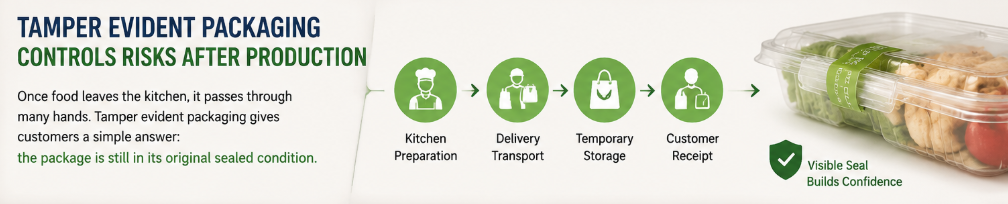
Many people associate tamper evident packaging only with preventing unauthorized opening. However, for food companies, the actual purpose is much broader.
The main challenge starts after production.
A restaurant preparing hundreds of meals every day needs packaging that can maintain product condition during delivery. A supermarket supplier needs packaging that can protect products while moving through storage and display processes.
A visible tamper feature gives customers a simple answer: the package they received is still in its original sealed condition.
For large food operators, this reduces uncertainty between production and consumption. A custom tamper evident packaging manufacturer can also adjust the structure according to different products instead of forcing every application into one standard design.
Different Products Require Different Tamper Evident Structures
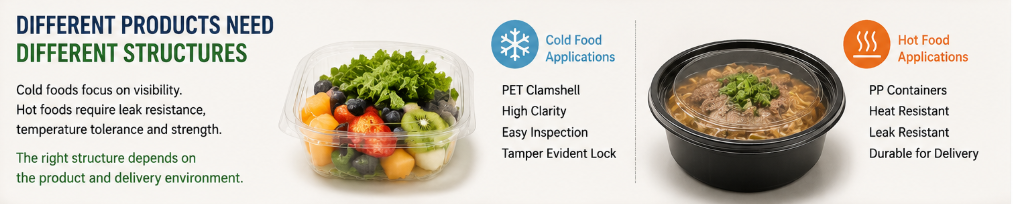
There is no single tamper evident package suitable for every food category.
Cold food products usually focus on visibility. Items such as salads, fruits, desserts, and bakery products often rely on clear packaging because appearance directly affects purchasing decisions.
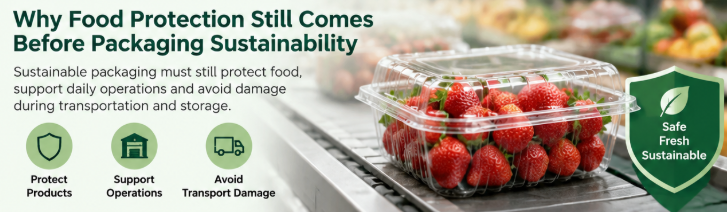
PET clamshell containers are commonly used in these applications. The transparent structure allows customers to see the product while the locking design provides evidence if the package has been opened.
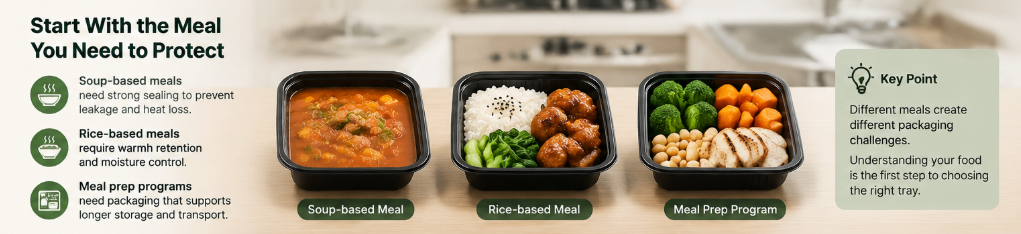
Hot food products have different requirements. Containers used for noodles, soups, and takeaway meals need to consider temperature, leakage, and transportation pressure.
A package that works well for a chilled fruit box may not perform well for a hot meal delivered over a longer distance.
This is why experienced suppliers usually evaluate the product first before recommending a structure. An OEM tamper evident packaging supplier should understand the complete usage environment, including filling process, storage conditions, and delivery method.
Material Selection Should Match The Product Environment
Choosing the right material is not simply about selecting the cheapest option.
PET is widely used when product visibility is a priority. Its clear appearance makes it suitable for retail products where customers need to inspect freshness before purchase.
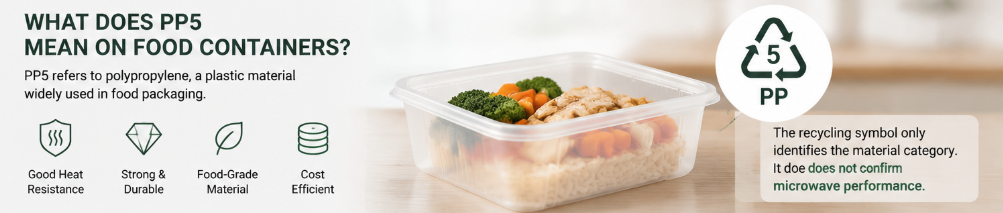
PP is often selected for applications involving higher temperatures. Many takeaway food products require packaging that can maintain shape and performance when exposed to hot contents.
Some brands are also exploring recycled materials because of sustainability goals. However, recycled content, transparency, strength, and food contact requirements must be considered together.
A suitable material depends on where and how the packaging will be used.
A professional tamper evident packaging supplier for food manufacturers should be able to explain the practical differences between materials rather than only providing basic specifications.
What Procurement Teams Should Check Before Ordering
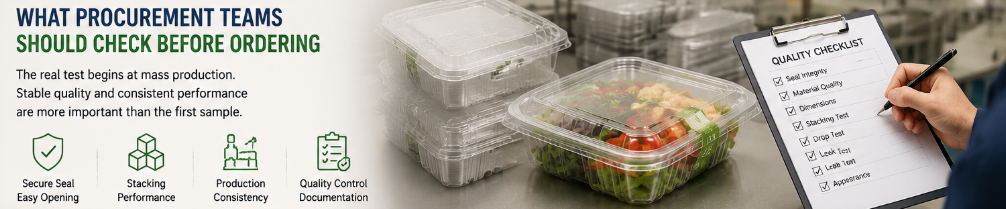
The first sample is rarely the biggest challenge. The real test begins during mass production.
A package may look perfect during sampling but experience problems when produced in large quantities. Small differences in mold accuracy, material thickness, or locking structure can affect final performance.
Procurement teams usually need to check several areas before confirming a supplier.
The sealing structure should remain secure during transportation. At the same time, customers should not struggle when opening the package.
The stacking ability is also important, especially for warehouses and distributors handling large volumes.
Production consistency matters just as much as the initial design. A supplier that cannot maintain stable quality can create problems even if the first batch performs well.
Working with an experienced tamper evident packaging factory for bulk orders allows buyers to evaluate production capability before scaling up.
Common Purchasing Mistakes With Tamper Evident Packaging
One mistake is focusing only on appearance.
A transparent package may look attractive, but appearance alone does not determine whether it is suitable for commercial use.
Another mistake is choosing packaging based only on current needs. Food companies often expand product lines or enter new sales channels. Packaging that works for local delivery may not be suitable for retail distribution later.
Some buyers also underestimate the importance of mold and production experience.
Tamper evident structures depend heavily on precise design. A small problem in the locking area can affect the entire product performance.
Instead of asking only about price, procurement teams should understand how the supplier develops, tests, and improves packaging designs.
Finding A Tamper Evident Packaging Partner For Long-Term Supply
The right supplier is not simply a company that can produce plastic containers.
For long-term cooperation, buyers usually need a manufacturer that understands product development, production control, and market requirements.
OEM and ODM capabilities are valuable when standard products cannot fully match a brand’s needs. Adjustments in size, structure, material, and appearance may be required depending on the application.
Quality documentation, production capacity, and communication efficiency are also important factors during supplier evaluation.
A capable ODM tamper evident packaging factory can support companies from initial product ideas through final production, making future adjustments easier as business requirements change.
Tamper Evident Packaging Is A Part Of The Customer Experience
Packaging is often the final interaction between a food company and its customers.
A well-designed tamper evident package does not attract attention because it works quietly in the background. Customers simply receive their food, check the package condition, and feel confident about what they are about to consume.
For restaurants, retailers, and food manufacturers, the decision is not only about selecting a container. It is about choosing packaging that matches the way products are produced, transported, and experienced by customers.
A reliable tamper evident packaging manufacturer for commercial applications can help create packaging that fits real operating conditions rather than just meeting basic requirements.