If you are sourcing disposable food packaging for a foodservice chain, a grab-and-go retail program, or a private label consumer goods line, the question seems simple: what is the standard size of a cereal bowl? A quick search might tell you 14 to 16 centimeters in diameter, holding 350 to 500 milliliters. That number is easy to find but dangerously incomplete. In the world of single-use plastic packaging, a dimension without context leads to products that look adequate on a spec sheet but leak during transport, collapse under modest heat, or fail to communicate portion value on a cold shelf.
This guide moves past generic specifications. It translates real-world handling, visual merchandising in chilled display cases, lid compatibility requirements, and content-driven retail into a practical sizing strategy for disposable plastic cereal bowls.
Beyond the Measurement: Handling and Lid Integrity as a Sizing Compass

Working with any custom disposable plastic cereal bowl manufacturer begins with a diameter decision, but that number should not come from a generic kitchenware sizing chart. It must derive from the interplay between the user's one-handed grip, the bowl's flexibility under load, and the sealing integrity of the matching lid. A thin-walled plastic cereal bowl in the 13.5 to 14.5 centimeter rim diameter range allows an adult to securely hold it with one hand while navigating a self-serve station or eating on the go. A wider bowl made from lightweight material flexes too much when filled, risking lid pop-off or content spillage into a bag.
The rim design matters critically for disposable formats. A rolled or reinforced rim allows a snap-on or heat-seal lid to engage with a reliable, audible click. A sharp, flimsy, straight-cut rim often fails to hold a seal, leading to leaks that destroy a consumer's commute or a retailer's shelf presentation. This is not a minor detail. It determines the complaint rate for a grab-and-go breakfast program. When briefing an OEM plastic cereal bowl factory for foodservice chains, do not simply request a diameter. Mandate a rim profile and wall thickness that pass a one-handed squeeze test with a filled, lidded bowl, and reject any design that deforms or unseals under moderate lateral pressure.
Visual Portion Perception in the Chilled Grab-and-Go Aisle
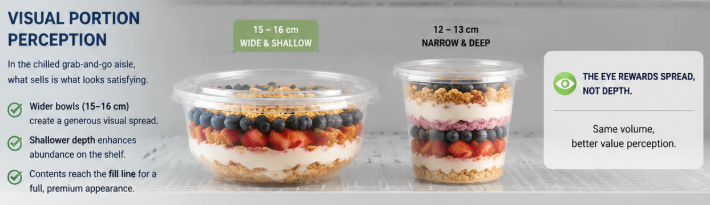
Shelf-based and refrigerated display case retail operate on perceived value. For a single-use plastic cereal bowl, capacity in milliliters does not drive the perception of a satisfying meal; surface area and fill-line placement do. A wide, shallow disposable bowl with a 15 to 16 centimeter diameter displays cereal, fruits, and toppings across a generous visual plane. It signals abundance even when the actual gram weight matches a narrower, deeper competitor. The eye rewards spread, not depth.
This principle matters to any private label disposable food container supplier serving supermarket ready-to-eat programs. A grocery buyer compares your 400-milliliter plastic cereal bowl side by side with a competitor's on a refrigerated shelf. The wider, slightly shallower bowl reads as the better value proposition at identical cost per unit. The specification that secures the listing is not internal volume; it is visual footprint under fluorescent or LED case lighting. The sidewall angle must also prevent contents from settling into a tight, unappealing mound at the center and instead encourage a natural, abundant-looking distribution right up to the fill line.
The Hidden Constraint: Lid Stock, Stacking, and Transport
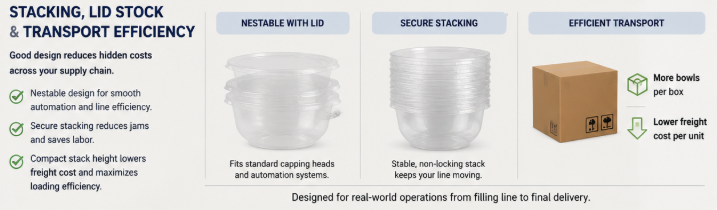
A disposable plastic cereal bowl that cannot nest efficiently with its lid fleet or stack securely in transit generates hidden costs that erode margin across the supply chain. If the bowl height exceeds the nesting interval for the lid application machine, automation fails. If the tapered angle is wrong, stacked empty bowls lock together and slow down line speed at the filling station. These operational friction points are invisible on a product page but dominate packing line manager complaints.
This is a vital filter when evaluating samples from a large-volume plastic cereal bowl manufacturer for wholesale distributors. A total height that allows stable nesting without jamming, combined with a consistent rim diameter that matches a standard capping head, streamlines both manual and automated filling lines. Shipping configurations matter equally. A design that stacks with minimal wasted air volume reduces per-unit freight cost, a decisive factor for a distributor moving containers across regions. Providing stacking height per hundred units and confirming compatibility with common automatic lid application systems transforms a sample submission into a logistics-ready proposal.
One Bowl Across Multiple Cold Chain Dayparts
A disposable plastic cereal bowl in a foodservice or retail environment rarely holds only cereal. It appears in yogurt parfait programs, fruit salad cups, snack mix kits, and dessert pots. A contract-grade disposable catering bowl producer must therefore engineer a form that accommodates wet, semi-solid, and dry contents interchangeably. A cereal bowl requires sufficient depth so milk plus toppings do not breach the headspace needed for lid sealing. Yet the same bowl used for a layered parfait benefits from slightly straighter sidewalls that display ingredient striping attractively.
The practical balance sits around 5 to 6 centimeters in depth matched with a 14 to 15 centimeter rim diameter. This profile prevents the deep, narrow bucket look that limits a cereal bowl's function to a single menu item and discourages multi-use adoption by the kitchen team. For a custom single-use plastic cereal bowl vendor working with contract caterers and commissary kitchens, a single versatile spec that performs across cereal, soup, salad, and dessert simplifies procurement, reduces SKU count, and raises the perceived utility of the entire program.
Translating Dimensions into Purchasing Confidence for Buyers
A rim diameter expressed in millimeters conveys nothing to a busy foodservice buyer scanning supplier catalogs. The most effective way to communicate size is to embed it in an operational reference frame. A 400-milliliter disposable plastic cereal bowl that accommodates a standard 250-milliliter portion of cereal plus 150 milliliters of milk with adequate headspace for sealing becomes an instantly usable specification. Showing the bowl alongside a common single-serve milk carton or a standard granola pouch builds a mental model of portion fit.
This visual specification toolkit should be a routine deliverable from any ODM disposable cereal bowl producer for international retail buyers. Supplier catalogs that pair technical drawings with portion-reference photography reduce pre-order sampling back-and-forth and minimize the risk of products arriving that fail the fill-and-seal test on day one. A packaging company that consistently anchors its dimensions in operational scenarios builds trust that translates directly into repeat orders.
Specifying for Real-World Success in Disposable Packaging
The specification sheet for a well-engineered disposable plastic cereal bowl therefore reads less like a dimensional table and more like a performance warranty. It confirms a rim diameter that enables secure one-handed handling without flexing, a rim design that locks reliably with the nominated lid range, a total height that clears automated filling and sealing equipment, and a depth-to-width ratio that performs visually on the chilled shelf while maintaining the required headspace for milk and toppings. These are the precise criteria a large-scale disposable cereal bowl supplier for global food packaging networks must satisfy to move from initial sample approval to sustained volume orders.
Approaching a custom disposable plastic cereal bowl manufacturer for high-volume contract packing with this kind of performance brief elevates the sourcing conversation. It signals that the buyer understands the product must work in a cold chain, on a filling line, on a retail shelf, and in a consumer's hand during a rushed morning commute. The standard disposable plastic cereal bowl is not defined by one inherited measurement, but by its flawless integration into this entire sequence of real-world conditions.