Your Bowl Is Really Three Foods Wearing One Hat
Nobody explains this at the counter. An açaí bowl looks like a single dessert, but it behaves like three separate items stacked together, and each one falls apart on its own schedule. The frozen base can hold for weeks if you treat it right. Sliced banana starts turning brown inside the hour. Granola is already losing the fight the moment it touches anything wet.
Once that clicks, the question changes. You stop wondering "how long does an açaí bowl last" and start deciding which layer you're willing to give up. That decision is the whole game.
The Toppings Are on a Thirty-Minute Clock
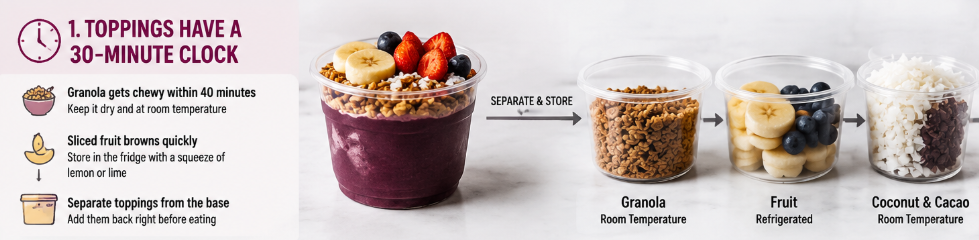
Put granola in a sealed container with cold purée and check it after forty minutes. It won't be crunchy. It'll be chewy in a way that's hard to forgive. Coconut flakes go the same way, just slower. Cacao nibs survive better than most, and honey or nut butter drizzled on top will slide down through the base and turn the bottom third watery overnight.
So the first real rule is dumb but effective: get the toppings off. Scrape them into a small dry container or a snack bag, and store them at room temperature, not in the fridge. Cold air in a home refrigerator carries moisture, and granola picks it up. Sliced fruit is the exception — that goes in the fridge, in its own little pot, with a squeeze of lemon or lime if you care about the banana looking edible tomorrow.
It takes about ninety seconds. It's the difference between a decent second breakfast and something you'll poke twice and throw out.
Walking In the Door With Half a Bowl

Say you bought a large, ate two-thirds, and drove twenty minutes home. The edges have already melted. Here's the honest version: that bowl will never be smooth again.
Refreezing a purée that has thawed lets the water reorganize into large ice crystals. When you dig in the next day, you get grit and a puddle at the bottom. Any frozen acai bowl manufacturer for café franchise groups will say the same thing on their spec sheets — thaw once, then use it. That's not marketing caution, it's just physics you can taste.
What you should actually do is stir the melted rim into the rest so it's uniform, transfer it to a small jar, press a piece of parchment flat onto the surface so no air sits on top, seal it, and put it in the coldest part of the freezer — the back of a bottom shelf, never the door. Eat it within a day or two, and expect to stir it hard for ten seconds before it looks like food again. If it came from a shop that portions cups through a private label acai bowl factory for wholesale buyers, the cup lid is usually decent enough to reuse; the flimsy clamshells are not, and food wrap plus a rubber band beats them.
If the bowl had yogurt, milk, or protein powder in the blend and it sat in a warm car for more than two hours total, skip all of the above. That one goes in the bin.
Base Alone: Smooth for a Week, Edible for Three Months
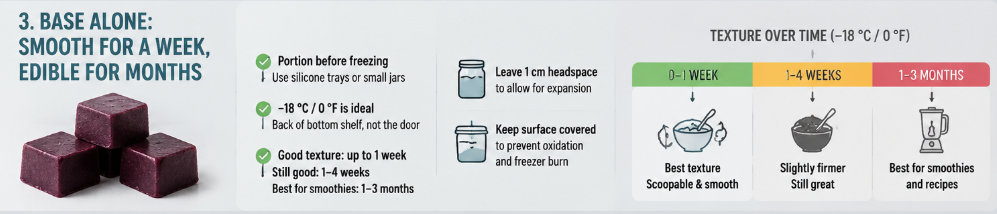
Batch prep is where storage actually pays off. Blend your base thick, no toppings, no dairy if you can help it, then portion it before freezing rather than after. Silicone cube trays are the trick nobody uses enough — freeze the base into cubes, pop them into a zip bag, and you can pull three or four cubes for a single serving without thawing the whole slab.
In a freezer holding steady at −18 °C, texture stays genuinely good for about a week. Between one and four weeks it's still pleasant but a little firmer. Past a month you're in "this makes a great smoothie" territory rather than "this makes a great bowl." That's not spoilage, just texture drift, and knowing the difference saves a lot of unnecessary waste.
Two details matter more than the container brand. Leave a centimetre of headspace, because purée expands and cracks glass. And keep the surface covered — the deep purple oxidizes to a dull grey-brown where air touches it. That colour shift is cosmetic, not dangerous. Cafés buying base in cases from a bulk acai bowl producer for foodservice distributors deal with the same thing and simply skim the top layer.
Unopened commercial pouches are a different story. Follow the printed instructions, since every OEM acai bowl supplier writes slightly different thaw guidance depending on whether the pulp is pasteurized and whether sugar was added. Open one, use one. Half a pouch left over should go into a covered cube tray immediately rather than back into the box with a folded corner.
When the Texture Is Gone, the Food Usually Isn't
This is the part most storage guides skip. A grainy, weeping base is not garbage — it's an ingredient.
Pour it into popsicle moulds with a little coconut milk and you've got something better than what you started with. Use it as the frozen component in a smoothie and nobody will ever know. Stir it into chia pudding overnight, swirl it through yogurt, fold it into muffin batter in place of mashed banana. Refrozen base blends beautifully even when it no longer scoops beautifully. The grab-and-go cups developed with an ODM acai bowl supplier for retail chains are formulated with stabilizers precisely because retail can't rely on customers doing any of this, but at home you have options a shelf-stable product doesn't.
The only salvage path that's closed is the safety one. If it spent too long warm, no recipe fixes that.
Trust Your Nose, Not the Colour
Colour tells you about oxygen. Smell tells you about time. A sour, winey, faintly fermented note means the sugars have been working, and that bowl is finished. Same for any sliminess on the surface, visible fuzz, or a topping mix that smells like old oil. Thick frost inside the bag means the freezer has been cycling warm and cold, and while it's safe, quality is long gone.
Dates help too. Cases from a wholesale acai bowl factory are lot-coded for a reason, and there's no harm in writing the date on your own jar with a marker. It's a habit borrowed from anyone who has run a kitchen — the same one used by an acai bowl co-packer for private label brands and by a contract acai bowl supplier for grocery programs, just scaled down to your freezer door.
The Short Version
Separate the layers, cover the surface, portion before freezing, keep it at the back of the bottom shelf, and decide in advance whether you're storing for texture or just for use. Even the sorbet-style pucks made by a custom acai bowl manufacturer follow the same logic. Do those five things and you'll throw out far less than you used to.