If you are buying disposable forks for foodservice, takeaway, catering, or distribution, the question is not simply whether plastic forks are banned. The more useful question is whether the specific fork can still be manufactured, imported, supplied, or used in your target market.
That distinction matters because plastic cutlery rules are not identical everywhere. A product that can still be supplied in one market may be restricted or prohibited in another. For buyers placing bulk orders, checking the market before production is far safer than discovering a problem after the goods arrive.
Are Plastic Forks Actually Banned?

There is no single worldwide ban covering every plastic fork. Regulations usually focus on single-use plastic cutlery, and the exact restriction depends on the market.
In the EU, the Single-Use Plastics Directive identifies single-use plastic cutlery, including forks, knives, spoons and chopsticks, as products subject to a placing-on-the-market ban. The EU definition of plastic is also broader than many buyers expect. It covers certain polymer-based materials, including bio-based and biodegradable plastics.
England takes an even more direct approach. Since October 2023, businesses have been prohibited from supplying single-use plastic cutlery, including forks, whether supplied online or over the counter.
For an OEM plastic forks manufacturer, this means the destination market should be established before discussing material, tooling, or production volume. “Plastic fork” is not a globally interchangeable product category from a compliance perspective.
Where the Fork Will Be Sold Matters More Than Where It Is Made

A common purchasing mistake is to ask whether a product is legal “in general.” For disposable foodservice products, the better question is: where will the product be placed on the market?
An exporter may manufacture the same fork for several countries, while the buyer has to meet different requirements in each destination. This becomes especially important for distributors serving multiple regions.
An export plastic forks supplier for foodservice distributors should therefore be able to discuss the intended market rather than simply provide a material specification and unit price.
The EU framework is particularly important because its definition covers products made wholly or partly from plastic. The European Commission's updated guidance also confirms that single-use cutlery made partly from plastic can fall within the scope of the rules.
For the United States and other markets with more fragmented rules, buyers should not assume that a product is acceptable nationwide simply because there is no single federal ban. State and local requirements can change the answer.
Does Switching to PLA or Compostable Plastic Solve the Problem?

Not necessarily.
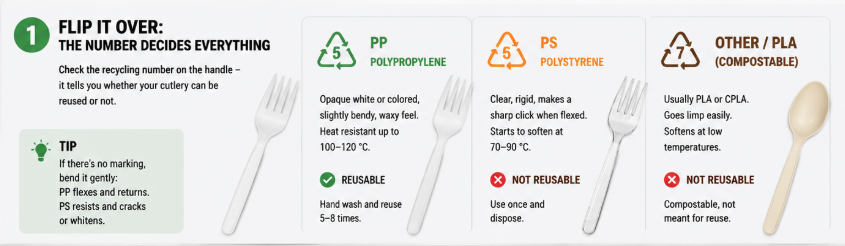
This is one of the most important points when replacing conventional disposable forks. A supplier may describe a product as biodegradable, compostable, or plant-based, but that description alone does not determine whether the product falls outside a plastic restriction.
EU rules specifically state that bio-based and biodegradable plastics can still fall within the definition of plastic under the Single-Use Plastics Directive.
That means replacing a conventional plastic fork with a PLA fork should not be treated as an automatic regulatory solution.
For a custom plastic forks factory serving international buyers, the more useful approach is to identify the regulation first and then select the material that fits both the legal requirements and the customer's application.
What About Existing Inventory?
This is where regulations become a supply-chain issue rather than simply a product issue.
Suppose a distributor has already purchased several months of stock. A new restriction may create questions about whether that inventory can still be supplied, whether a sell-through period exists, and whether importing additional stock before an effective date is worthwhile.
The answer depends on the specific regulation. Buyers should check the effective date and transition provisions rather than assuming that an announced ban means every existing item becomes unusable overnight.
This matters even more for large-volume orders. A bulk plastic forks manufacturer for catering and takeaway suppliers may be able to produce the same SKU at a lower unit cost, but a large MOQ becomes a liability if the destination market is about to restrict that product.
What Should Buyers Ask Before Ordering?

The safest purchasing process is to treat compliance as part of the product specification.
Before placing a large order, confirm what the fork is made from, whether it is considered single-use plastic in the destination market, which regulation applies, and what supporting documentation the supplier can provide.
If the product is marketed as compostable or biodegradable, ask what certification or test documentation supports that claim. If recycled content is advertised, confirm the actual material composition rather than relying on a marketing description.
A private label plastic forks supplier for restaurant chains should also be able to keep the material and specification consistent between production batches. This becomes particularly important when the product is being sold under the buyer's own brand.
Choosing a Replacement Is Not Just a Material Decision

When conventional plastic forks are restricted, the cheapest replacement is not automatically the best replacement.
A buyer supplying hot meals may care more about rigidity and heat performance. A catering distributor may prioritize breakage resistance, packaging density, and transport cost. A sustainability-focused foodservice customer may care about compostability certification and the disposal system available in its market.
This is why an ODM disposable forks manufacturer for wholesale distribution should be evaluated on more than the piece price.
The replacement also needs to work operationally. A fork that meets a sustainability claim but breaks easily, requires significantly more packaging, or costs much more to transport may create a different supply problem.
The Practical Way to Source Plastic Forks
For buyers, the safest sequence is straightforward: identify the destination market, determine whether the product is legally restricted there, confirm how the material is classified, check the effective date, and only then finalize the product specification.
If conventional plastic forks are unsuitable, compare alternatives based on compliance, performance, total landed cost, and supply reliability rather than choosing a material simply because it sounds more sustainable.
An industrial plastic forks manufacturer with OEM and ODM capability can then develop the appropriate specification around the actual market instead of producing a generic fork first and trying to solve compliance afterward.
The key point is simple: plastic forks are not subject to one universal rule. The real procurement question is whether this specific fork, made from this specific material, supplied in this specific way, can legally reach the customer's target market. Getting that answer before production can prevent rejected shipments, stranded inventory, and expensive supplier changes later.