The Short Answer, Before You Wash Anything
Some of it, yes. Most of it, no — and the difference is stamped on the handle.
If the fork in your hand is clear, rigid, and makes a sharp click when you flex it, it's almost certainly polystyrene, and it belongs in the bin after one meal. If it's opaque white or colored, slightly bendy, and feels a bit waxy, it's polypropylene, and you can realistically get five to eight meals out of it if you wash it by hand. Everything else — unmarked airline-style sets, compostable PLA, bamboo-plastic hybrids — isn't worth the gamble. That's the whole guide in a paragraph. The rest is how to tell which is which and when to stop.
Flip It Over: The Number Decides Everything
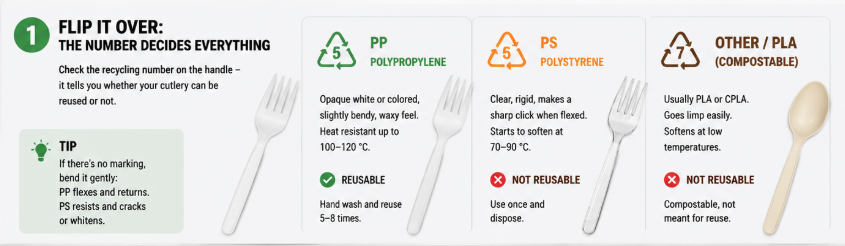
Look for the small triangle on the handle or the back of the spoon bowl. A 5 means polypropylene, which softens somewhere around 100–120 °C and shrugs off warm dishwater. A 6 means polystyrene, which starts going soft and stress-cracking closer to 70–90 °C — well within reach of a hot tap. A 7, or a "compostable" leaf logo, usually means PLA or CPLA, and those go limp faster than anything else on the table.
Plenty of cutlery has no marking at all, because takeaway sets are molded thin and cheap and the tooling skips the symbol. In that case, judge by behavior: bend the tines gently. Polypropylene flexes and returns. Polystyrene either resists then snaps, or whitens along the crease. That whitening is the material tearing internally, and it never heals. A custom plastic cutlery manufacturer chooses between those two resins mostly on price and clarity, not on whether you'll wash the thing — which is exactly why the decision lands on you.
Some Forks Are Done Before They're Dirty
Material is only half of it. What the utensil touched matters more.
Anything that met raw meat, raw egg, or raw seafood goes out. Not because plastic is uniquely dangerous, but because the tine gaps and micro-scratches on a molded fork are a bad place to try to guarantee a kill, and hand-washing at tolerable temperatures won't reliably do it. Same verdict for heavy grease and oily sauces: fat clings inside scratches, and the utensil will smell faintly of last week's curry no matter how long you scrub.
The other hard line is social. Rewashing party cutlery and putting it back out for guests reads as cost-cutting the moment someone notices a cloudy fork. If you run events or a small food business, don't. Any OEM disposable plastic cutlery supplier will confirm the same thing in writing: single-service items are validated for one use, and reusing them shifts liability squarely onto whoever served the meal.
Low-risk leftovers — cake forks, fruit spoons, salad utensils that only touched dressing — are the honest candidates for a second life.
The Dishwasher Is What Kills Them
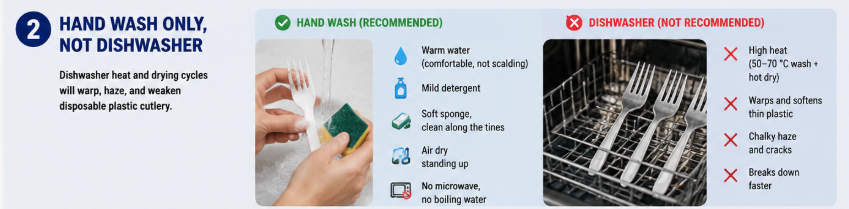
I ran a batch of twelve identical PP forks through a comparison out of curiosity. Six went in the dishwasher's normal cycle with heated dry, six got a sink wash in water hot enough to be uncomfortable but not scalding, with regular dish soap and a soft sponge.
The dishwasher group was visibly finished by the third cycle: two forks warped at the neck, one lost its shape completely against the heating element, and all six had a chalky haze. The hand-washed group looked usable at cycle eight. Wash water in most home machines sits around 50–70 °C, but the drying element runs considerably hotter, and thin-walled molded cutlery has nothing to resist it. So: warm water, mild detergent, soft sponge along the tines, air dry standing up, and never microwave it. Skip boiling-water "sterilizing" too — it deforms the piece and buys you very little.
Camping without hot water? Wipe the utensil clean immediately, before residue sets, then wash properly at the first opportunity. Cold rinsing alone is a holding action, not cleaning, and it's another reason a wholesale plastic cutlery factory ships these things as one-and-done.
How Many Times, and How It Tells You It's Finished
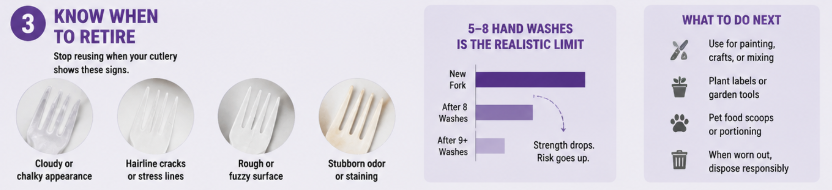
Five to eight hand washes is the realistic ceiling for polypropylene. I also measured how much force it took to snap a fork; a fresh one resisted noticeably longer than one that had been washed six times, and by the ninth wash they were breaking under normal pressure against a chicken breast.
You don't need a scale to know. The utensil announces its own retirement: a cloudy or chalky look where it used to be glossy, hairline lines in the gaps between tines, a surface that feels rough or slightly furry under your thumb, a stubborn smell, or any staining. One of those signs means it's done. This is also the point where the economics of a bulk plastic cutlery supplier for catering chains stops resembling the economics of your kitchen drawer — they're pricing per event, you're pricing per fork.
Microplastics, Without the Panic
Scratched, aged, heat-stressed plastic sheds more particles than smooth new plastic, and hot, oily, acidic, or alcoholic contents accelerate the migration of additives. That's the mechanism worth knowing, and the useful conclusions are boring and practical: don't microwave it, don't leave it sitting in tomato sauce or vinaigrette, don't use it to stir hot oil, and retire it once the surface roughens.
Whether that residual exposure harms you at these amounts isn't settled, and I'm not going to pretend it is. What is clear is that scratched cutlery contributes more than intact cutlery, so the retirement signals above do double duty.
That Drawer Full of Leftovers
Kerbside recycling almost certainly won't take them. Cutlery is small, light, and often unmarked, so sorting facilities can't separate it economically — it falls through screens or gets treated as contamination. Telling people to "just recycle it" is the single most common piece of bad advice on this topic.
So use them up instead. They stir paint and epoxy, scrape sealant into a corner, work as plant labels, portion pet food, and mix resin without anyone caring about scratches. Unopened, sealed packs are worth offering to a food bank or community kitchen, which is more than most private label plastic cutlery manufacturer for retail brands programs manage with their own overstock.
When Reuse Stops Making Sense
If you're washing forks daily, a stainless or bamboo travel set pays for itself in roughly two or three weeks of lunches, and it won't snap mid-meal. The real friction is rinsing it at the office and carrying it home, so choose a set with a case you'll actually clean. Businesses face the same calculation at a different scale, which is why an ODM cutlery producer for foodservice distributors now sells thicker reusable lines beside disposables, and why a PP cutlery exporter for hospitality procurement groups will quote reusable SKUs unprompted. If you're sourcing for repeat service, ask a custom-molded cutlery vendor for event rental companies for wash-cycle ratings rather than trying to stretch single-use stock.
Reuse the polypropylene, hand-wash it, watch for haze, and stop at eight.