When companies purchase food packaging in bulk, material selection is rarely decided by a single specification. Buyers usually need to consider what happens after the packaging leaves the factory.
A container may be transported hundreds or thousands of kilometers before reaching a restaurant or retailer. During this process, it needs to handle stacking pressure, vibration, temperature changes, and repeated handling. A material that looks strong in a product sample may not always perform well in daily commercial use.
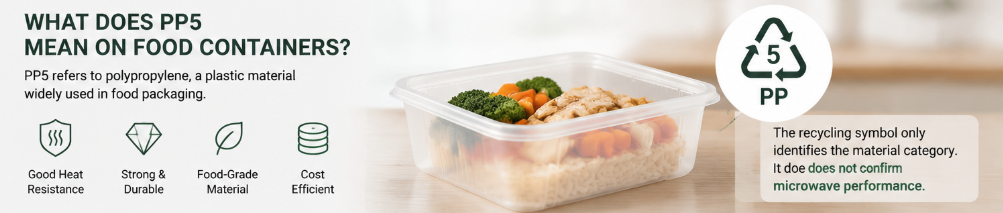
This is where PP5 plastic has gained popularity. Compared with PET, PS, PLA, and other common plastics, PP5 is valued for its overall performance rather than one outstanding feature. It provides a practical combination of toughness, heat resistance, and manufacturing flexibility.
For companies working with a custom PP5 food container manufacturer, understanding the real differences between PP5 and other materials helps reduce mistakes during packaging selection.
PP5 Plastic Strength Depends On Real Usage
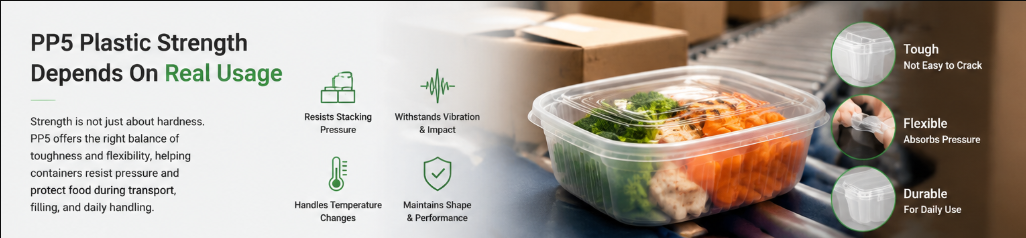
The word “strong” can mean different things in food packaging.
A rigid container may feel strong when held in the hand, but rigidity alone does not determine whether it can survive commercial use. During transportation, packaging needs to handle external pressure without cracking. During filling, it needs to maintain shape after contacting food at different temperatures.
For example, a clear container designed for supermarket display has different requirements from a takeaway box used for hot meals.
The first one may focus on appearance. The second one needs durability and heat performance.
PP5 performs well because it does not rely only on hardness. Its structure allows a certain amount of flexibility, helping the container absorb pressure instead of breaking immediately.
For daily foodservice applications, this balance is often more valuable than simply choosing the hardest material available.
Why PP5 Is Suitable For Hot Food Containers
Heat resistance is one of the main reasons polypropylene is widely used in commercial food packaging.
Many food businesses handle products that are filled while still warm or hot. Lunch meals, cooked dishes, soups, and ready-to-eat products all place higher demands on packaging materials.
Some plastics perform well at room temperature but become less stable when exposed to heat. This can lead to softening, deformation, or poor sealing performance.
PP5 is better suited for these conditions because it maintains its structure when temperatures increase.
For restaurants and meal delivery businesses, this creates a more reliable customer experience. A container should not only hold food; it should protect the product from production to consumption.
A professional OEM PP5 packaging supplier normally evaluates the complete usage scenario before selecting materials. The recommended solution depends on food type, temperature requirements, storage conditions, and transportation methods.
PP5 Compared With PET: Durability Or Product Presentation?
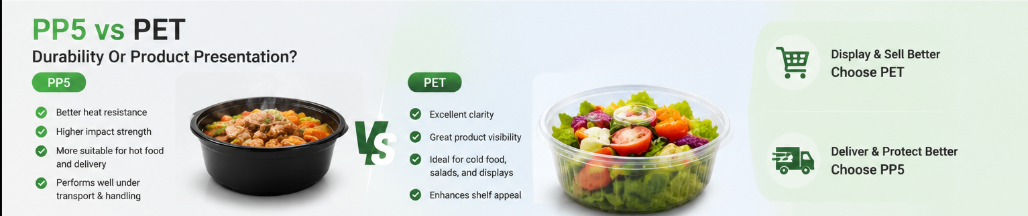
PET and PP5 are two materials frequently compared in food packaging, but their advantages are different.
PET is widely recognized for its excellent clarity. When customers need to see the product inside the package, PET provides a strong visual advantage.
This makes PET commonly used for products such as fruit packaging, salad containers, and chilled food displays where appearance directly influences purchasing decisions.
However, clear packaging is not always the best choice for every application.
When food containers need to handle heat, impact, or frequent movement, PP5 often performs better. A takeaway meal container faces more physical stress than a refrigerated display package.
For example, a salad bowl sitting in a supermarket refrigerator mainly needs transparency and presentation. A meal box moving through a delivery network needs stronger resistance against pressure and temperature changes.
An experienced PP5 food packaging factory usually helps buyers choose materials based on the actual working environment rather than simply comparing basic material features.
PP5 Compared With PS: The Hidden Cost Behind Cheap Packaging
PS has been used in disposable packaging because it offers low production costs and lightweight characteristics.
For some applications, this can still be useful. However, large-scale buyers need to consider the entire operating process, not only the purchase price.
Packaging damage can create additional costs that are difficult to calculate at the beginning. Broken containers, unstable performance, and customer complaints may affect delivery efficiency and brand reputation.
Compared with PS, PP5 provides better toughness and improved resistance during transportation and handling.
This difference becomes more noticeable for companies ordering large quantities. When packaging is used every day across multiple locations, consistency becomes a major factor.
Many businesses choosing a wholesale PP5 container supplier focus on reducing long-term problems instead of only searching for the lowest unit price.
PP5 Compared With PLA: Choosing The Right Material For The Right Purpose

PLA has become popular because of its compostable image and connection with sustainable packaging trends.
For certain products, PLA can be a suitable option. Cold food, desserts, and applications with lower temperature requirements can benefit from its environmental positioning.
However, material selection should always match actual operating conditions.
If packaging needs to handle hot meals, long-distance transportation, or frequent handling, PP5 usually provides more stable performance.
A common mistake among buyers is choosing a material based only on one advantage. A package must first complete its basic function: protecting food and maintaining usability.
A responsible OEM food packaging manufacturer will consider sustainability goals together with temperature requirements, product protection, and supply reliability.
Why PP5 Remains Popular In Commercial Food Packaging
Large food businesses are not only buying containers. They are building a stable packaging supply system.
For companies operating restaurants, food brands, or distribution networks, packaging consistency is extremely important. A small difference in size, lid fitting, or material performance can create problems when products are used repeatedly.
PP5 is suitable for many commercial packaging designs because it can be manufactured into different shapes and structures. Food bowls, takeaway boxes, meal containers, and trays can all be developed according to different requirements.
Manufacturers can improve packaging performance through structural adjustments, such as changing wall thickness, strengthening specific areas, or improving lid locking systems.
For businesses developing their own packaging lines, working with a custom polypropylene packaging factory can provide better control over product development and long-term production stability.
What Makes A High-Quality PP5 Container?
The material itself does not determine the final quality.
Two containers made from PP5 can perform differently because of differences in design and manufacturing processes.
A well-designed container needs proper thickness distribution. If the structure is too thin in important areas, it may lose strength during transportation.
The connection between the container and lid is also important. A secure sealing structure helps reduce leakage risks and improves customer experience.
For bulk purchasing, production consistency is equally important. Buyers need suppliers that can maintain the same specifications across repeat orders.
An experienced ODM PP5 container manufacturer can help optimize designs before mass production, reducing the risk of quality problems after launch.
Is PP5 The Strongest Plastic For Food Packaging?
PP5 is not the hardest plastic in every category.
PET may be a better option when visual presentation is the priority. PLA may fit certain sustainability-focused applications. Other materials may also provide advantages in specific situations.
However, commercial packaging decisions are rarely based on one performance factor.
For many foodservice applications, PP5 offers a practical balance between impact resistance, heat performance, flexibility, and cost control.
For companies searching for a reliable bulk PP5 food container supplier, the key question is not whether PP5 is the strongest plastic available.
The more important question is whether the material can consistently perform throughout the entire supply chain.
In many takeaway, meal preparation, and foodservice applications, PP5 remains a preferred choice because it delivers dependable performance where businesses need it most.