Paper plates are often presented as the obvious alternative to plastic tableware. They are made primarily from paper, come from a renewable resource, and can look much more environmentally responsible on a product catalog.
But for foodservice operators, distributors, and packaging procurement teams, the decision is not quite that simple.
A paper plate can have a lower environmental impact in one application and create unexpected problems in another. The result depends on how the plate is manufactured, whether it uses a barrier coating, how well it performs during use, how far it travels before reaching the customer, and what happens after it is discarded.
For anyone sourcing disposable tableware in bulk, the better question is not simply whether paper plates are “eco-friendly.” It is whether the specific paper plate meets your performance requirements while creating a reasonable environmental footprint.
The Environmental Impact Starts Before the Plate Reaches Your Warehouse

The first mistake buyers make is judging a plate only by its visible material.
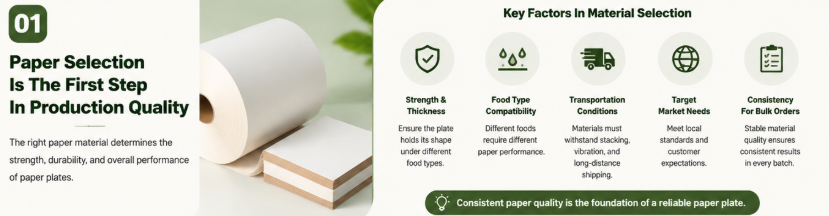
A paper plate may contain virgin paper fiber, recycled fiber, or a combination of different materials. The manufacturing process also requires energy, water, and other resources. Then there is packaging, transportation, warehousing, and distribution.
This is why a paper plates manufacturer for commercial foodservice should be evaluated beyond the basic material description. Two plates can both be marketed as paper products while having noticeably different specifications, weights, coatings, and supply-chain requirements.
For procurement teams, product weight is particularly interesting. A lighter plate generally uses less raw material and may reduce shipping weight. However, reducing material too aggressively can compromise stiffness and load-bearing performance.
If a plate bends under a heavy meal, leaks because it cannot handle sauces, or needs to be replaced after failing during service, the material saving becomes less meaningful.
The goal should therefore be an efficient product, rather than simply the thinnest product possible.
Does the Coating Make Paper Plates Less Sustainable?

This is where the environmental discussion becomes more complicated.
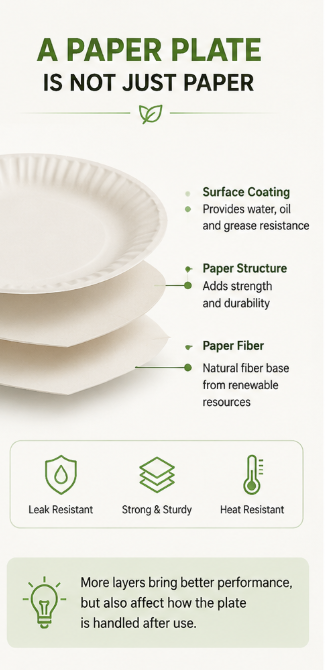
Many foodservice plates need some form of barrier protection. Hot foods, oily meals, sauces, and moisture can quickly weaken untreated paper. A coating can improve grease resistance and prevent liquids from penetrating the plate.
From a purchasing perspective, the question should not be “Does this plate have a coating?” but rather “What coating does it use, and what happens to the plate after use?”
For example, conventional plastic coatings may provide excellent performance but can complicate recycling. Other barrier technologies may be designed with compostability or different end-of-life requirements in mind.
A custom paper plates supplier should therefore be able to clearly explain the plate structure rather than simply using terms such as “green,” “eco,” or “sustainable” on the packaging.
The coating also needs to match the application. A plate intended for dry bakery products has very different requirements from one designed to hold greasy barbecue, curry, or hot prepared meals.
Choosing the least complicated material structure that still performs properly can be a more practical approach than choosing a product based only on an environmental marketing claim.
Can Used Paper Plates Actually Be Recycled?

“Paper is recyclable” sounds straightforward until the plate has been used.
Once a disposable plate is covered with food residue, grease, sauces, or liquids, its recycling situation can change. Local recycling programs also have different rules, and facilities do not necessarily accept every type of food-contact paper product.
This creates an important distinction between theoretical recyclability and practical recyclability.
A paper plate supplier for restaurant distributors should consider the target market when recommending a product. A plate that fits one region's waste-management system may not be the best choice in another.
The same principle applies to compostable products. A plate may be designed for commercial composting, but that does not mean a customer can simply place it into a backyard compost pile or guarantee that a local waste facility will accept it.
For buyers, the end-of-life pathway matters just as much as the material itself.
Are Compostable Paper Plates Always a Better Choice?

Compostability sounds like a simple environmental advantage, but it only becomes useful when the disposal infrastructure supports it.
If a foodservice business has access to a commercial composting program that accepts the relevant type of packaging, compostable plates may provide a practical end-of-life option. Without that infrastructure, the claimed advantage may be much less meaningful.
This is why a compostable paper plates factory for foodservice applications should not be assessed only on whether it can print “compostable” on the product specification. Buyers need to understand what the claim actually means, what certifications support it, and under what conditions the product is designed to break down.
The right product is the one that fits the waste system available to the customer, rather than the one with the most attractive environmental wording.
Paper Plates vs. Plastic Plates: Look at the Actual Application

It is tempting to declare paper better than plastic because paper is fiber-based. Real-world purchasing decisions are more complicated.
Consider a busy catering operation serving hot, wet, and oily food. If an inexpensive paper plate lacks sufficient strength, customers may experience leaks, bending, or spills. The business may then use two plates instead of one, or replace damaged meals.
In this situation, product performance becomes part of the environmental calculation.
On the other hand, using a heavier product simply because it feels more durable is not necessarily better either. The objective is to match construction with the intended application.
A wholesale paper plates manufacturer should therefore offer different specifications according to food type, portion size, required rigidity, and expected usage rather than treating every paper plate as an identical commodity.
Could a More Sustainable Plate Cause More Food Waste?
This is an overlooked issue in disposable food packaging.
The environmental impact of a plate cannot be separated completely from the job it is expected to perform. If the plate collapses under a heavy serving or allows liquid to soak through, the result can be wasted food as well as wasted packaging.
For a restaurant, caterer, or institutional buyer, this is more than a sustainability question. It is an operational problem.
A OEM paper plates manufacturer for catering companies should therefore be able to discuss practical performance alongside material options. Plate diameter, paper weight, forming quality, stiffness, edge construction, and grease resistance can all affect whether the product works reliably in real service conditions.
The most sustainable specification is often not the one that uses the least material. It is the one that uses an appropriate amount of material to complete the job without unnecessary failure or over-engineering.
What Should Buyers Ask Before Sourcing Paper Plates?
Before placing a large order, buyers should look beyond the phrase “eco-friendly paper plates.”
Ask where the paper fiber comes from, whether recycled content is available, what certifications apply, and what type of barrier is used. More importantly, ask whether the product can realistically be recycled or composted within the market where it will be sold.
Packaging efficiency also deserves attention. A private label paper plates supplier that can optimize stacking, carton quantity, and shipping configuration may help reduce unnecessary transport volume across a large order.
For distributors, this becomes particularly important. A small difference in plate weight or carton efficiency can become significant when multiplied across pallets, containers, and repeated shipments.
The supplier should also provide consistent specifications. If one production batch has noticeably different stiffness or coating performance from another, procurement teams may face product complaints that outweigh the theoretical benefits of choosing a particular material.
So, Are Paper Plates Bad for the Environment?
Not necessarily.
Paper plates are not automatically environmentally friendly simply because they are made from paper. At the same time, they should not automatically be considered environmentally harmful because some versions use coatings or require industrial composting.
The better approach is to look at the entire product system: raw material, manufacturing, coating, transportation, performance, and end-of-life treatment.
For buyers working with a paper plates factory for bulk distribution, the most useful question is therefore not “Is paper better than plastic?” It is:
Does this particular plate use materials efficiently, perform reliably in its intended application, and have a realistic end-of-life pathway in the market where it will be used?
That is a much more useful standard for making a responsible purchasing decision—and one that avoids reducing sustainability to a simple label on the package.