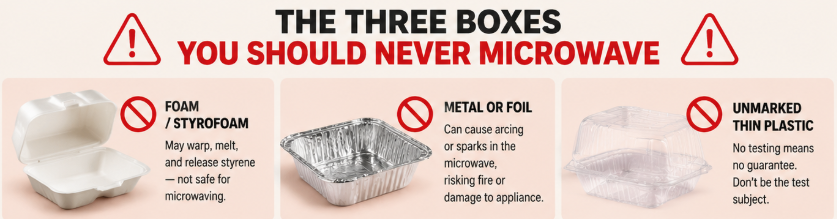
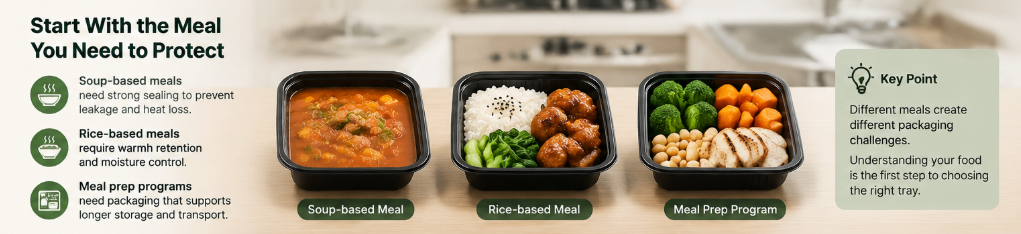
A plastic food tray may look perfectly suitable for reheating, but appearance tells you very little about how it will behave in a microwave. This becomes especially important when a tray is used for ready meals, frozen food, takeaway meals, or prepared food that goes directly from storage to reheating.
So, are plastic food trays microwave safe? Some are, but “plastic” by itself is not enough to answer the question. The actual material, tray construction, food, heating conditions, and lid all matter.
For food businesses buying packaging in volume, the better question is not simply whether a tray is microwave safe. It is whether the specific tray you are buying is designed and tested for your intended heating application.
Start With the Plastic, But Don't Stop There

Material is the first thing a buyer should check, but it should not be the final decision.
Polypropylene (PP) is widely used for food packaging where reheating is required because properly specified PP products can provide useful heat resistance. CPET is another option for applications requiring higher-temperature performance. Ordinary PET trays, meanwhile, are often selected for clarity and chilled-food presentation rather than general microwave reheating.
The important point is that a resin name does not automatically describe the performance of the finished tray. Wall thickness, tray geometry, additives, recycled content, forming conditions, and the exact grade can all affect the final product.
For this reason, a custom food tray manufacturer should be able to tell you more than simply “PP” or “PET.” The supplier should identify the material used in the finished article and the intended conditions of use.
FDA guidance also treats the finished food-contact article differently from the individual substance or material used to make it. In other words, the tray itself is what ultimately needs to match its intended application.
Microwave Safe Depends on More Than Temperature

A common mistake is to treat microwave suitability as a simple temperature question.
In actual use, the temperature reached by food packaging depends on factors including the food composition, heating time, food mass, food shape, and container shape. FDA guidance specifically recognizes these variables when discussing microwave-only food-contact containers.
That matters when choosing packaging for products such as curry, pasta, rice meals, soups, or other prepared foods. A tray that performs well with one food may experience a different thermal load with another.
Oil and fat can also create demanding heating conditions. A tray used for a low-moisture or high-fat meal should therefore not be evaluated in exactly the same way as a tray used for a watery food.
This is why a microwave food tray supplier should not give you a blanket answer without asking how the tray will actually be used.
Don't Forget the Lid
The tray itself is only half of the packaging system.
A customer may purchase a tray with a transparent lid, sealing film, or another closure. Even if the base is suitable for microwave reheating, that does not automatically mean the complete package can be heated in the same way.
The key questions are whether the lid is intended to remain in place, whether it needs to be removed or vented, and how steam is expected to escape during heating.
This becomes particularly important for prepared meals. Steam pressure, condensation, lid deformation, and sealing performance can affect the customer's experience just as much as the tray itself.
For a ready meal food tray manufacturer, microwave performance should therefore be considered as a complete packaging system rather than an isolated plastic component.
What About Frozen Food Going Straight Into the Microwave?
This is one of the more useful real-world applications to consider.
A frozen meal may remain in its packaging from freezer storage until the customer reheats it. That means the tray has to handle more than the final microwave temperature. It may first experience frozen storage and then a rapid transition into heating.
The FDA's food-contact guidance separately identifies frozen storage and frozen or refrigerated ready-prepared foods intended to be reheated in the container as specific conditions of use.
For a frozen meal tray factory, this means the specification should reflect the complete use cycle rather than focusing only on the microwave step.
If your product is designed for freezer-to-microwave use, tell the supplier that from the beginning. It can affect the material selection, tray design, thickness, and validation requirements.
What Should You Ask a Food Tray Supplier?
“Is this microwave safe?” is a useful starting question, but it is not a very complete purchasing specification.
A wholesale food tray supplier should be able to clarify the material, intended temperature range, recommended heating conditions, food-contact suitability, and whether the microwave claim applies to the finished tray.
You should also ask whether the claim applies to a particular heating time or power level. A product designed for short reheating is not necessarily suitable for prolonged cooking.
Food-contact compliance and microwave performance should also be treated as separate checks. FDA explains that food-contact substances are evaluated according to their intended conditions of use, including migration considerations.
That distinction is important when comparing suppliers. A tray being “food grade” does not by itself mean that it is suitable for microwave heating.
Test the Packaging With the Food You Actually Sell

Supplier documentation is important, but actual application testing can reveal problems that a material specification cannot.
If you are developing a new product, test the actual tray with the actual food and the intended microwave conditions. Testing a sample tray with water may not reproduce the heating behavior of a high-fat sauce, dense rice meal, or frozen prepared food.
Look at what happens after heating. Does the tray remain dimensionally stable? Does it become difficult to handle? Does the lid stay properly positioned? Is there leakage? Does the food release cleanly? Does the package remain suitable for serving?
These questions matter much more to a food business than simply seeing a “microwave safe” symbol.
For a private label food tray supplier, application testing is also a useful way to confirm that a customer's branded packaging performs as expected before a larger production run.
For Custom Trays, Make Microwave Performance Part of the Specification
Microwave requirements should be established before tooling begins if the tray is being customized.
A OEM food tray manufacturer should know whether the tray will be refrigerated, frozen, reheated, or used across several stages. The required food type, dimensions, capacity, material, wall structure, lid configuration, and heating conditions should be discussed before the final specification is locked.
This becomes even more important when changing tray dimensions or thickness. A design that works for one SKU should not automatically be assumed to perform identically after a major structural change.
For businesses developing several meal sizes, an ODM food tray factory can also evaluate whether the same material and design approach can support multiple SKUs without compromising the intended heating application.
So, Are Plastic Food Trays Microwave Safe?
Yes, some plastic food trays are designed for microwave use, but there is no universal answer for every plastic tray.
The safer purchasing approach is to look beyond the word “plastic” and verify the material, finished-tray specification, food application, heating conditions, lid configuration, and supporting documentation.
For buyers, the most useful question is therefore not:
“Is this plastic tray microwave safe?”
It is:
“Is this specific tray suitable for my food, my heating process, and my intended conditions of use?”
That question gives both the buyer and the food packaging tray manufacturer a much clearer specification to work with—and makes it easier to avoid choosing a tray based on a generic microwave-safe claim alone.