Let's be honest—everyone who orders takeout has done it. Food's gone cold, you're hungry, and the last thing you want is to dirty another plate. So you pop that plastic or foam container straight into the microwave, punch in a minute, and walk away.
Most of the time, nothing dramatic happens. The box doesn't melt into a puddle. There's no smoke, no sparks. So it's fine, right?
Not necessarily. "Didn't fall apart" is not the same as "safe." And the difference matters more than most people realize.
What "Microwave Safe" Actually Means
Here's something that might surprise you: when a to-go box says "microwave safe" on the label, that claim usually comes from a specific lab test. But here's the catch—that test often uses plain water, not oily, sugary, or salty food. And it measures whether the box physically holds up, not whether chemicals leach into your meal.
In other words, the box passes the test if it doesn't melt or warp. That's it.
Now think about what you actually reheat: leftover curry, greasy noodles, or that saucy stir-fry. These foods get much hotter than plain water. Oil can easily exceed 100°C (212°F) inside a microwave, and the container right next to it may not feel that hot to your touch. So even if the box looks fine afterward, the interaction between heat, fat, and the material is a completely different story.
The Three Boxes You Should Never Microwave
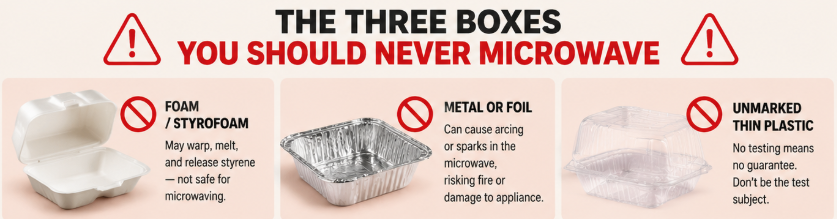
No labels, no debate. If your takeout container falls into any of these categories, just transfer the food. Period.
Foam or Styrofoam containers are the biggest offenders. They warp, they melt, and in some cases, they release styrene—a substance that's never a good thing to have near your food. If you see that crumbly, white, lightweight material, it's a hard no.
Anything with metal—folded handles, foil lining, or even metallic print—can cause arcing inside the microwave. That means sparks. Enough sparks can damage your appliance or, in worse cases, start a small fire. Not worth the risk.
Thin, flimsy clear plastic clamshells without any symbol on the bottom are a gamble you don't need to take. No marking usually means no testing. And no testing means you're the test subject.
Flip It Over: The Number That Matters
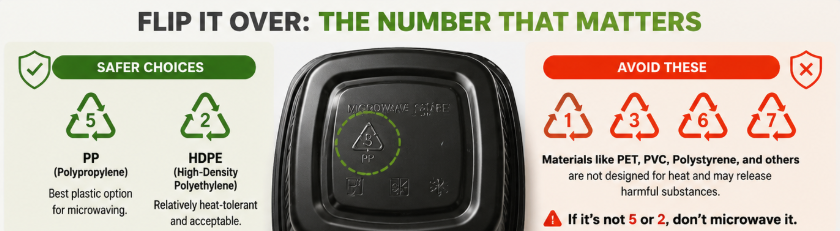
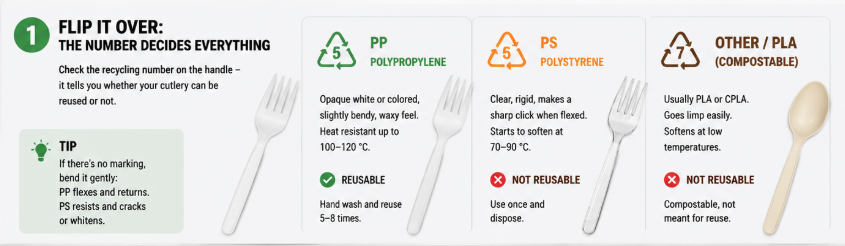
This is the single most useful habit you can develop. Flip your container over and look for the triangular recycling symbol with a number inside. It's not a guarantee of safety, but it tells you what you're working with.
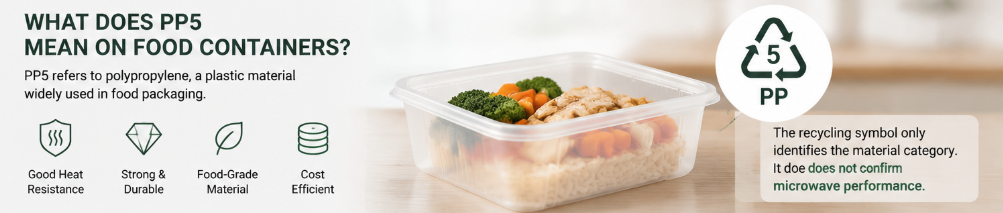
The only number worth trusting for microwaving is 5, which stands for polypropylene or PP. This material has decent heat resistance and is widely considered the best plastic option for reheating when you absolutely must use plastic.
Number 2, or HDPE, is also relatively heat-tolerant but appears less often in takeout packaging. It's acceptable, though PP remains the preferred choice.
Now the dangerous ones: 1, 3, 6, and 7. These include materials like PET, PVC, and polystyrene. They aren't designed for heat. And some of them, particularly number 7, can contain BPA or other compounds that manufacturers are still studying for long-term effects.
Here's the bottom line: if you see any number other than 5 or 2, don't put that box in the microwave. Even if you've done it before and nothing visibly happened.
Even the "Good" Boxes Have Rules
Okay, so you checked the bottom and it says 5. Does that mean you're in the clear? Not quite. Here's what most people overlook.
Fatty and sugary foods are more aggressive. Cooking oils, butter, cheese, and syrups reach higher temperatures than water-based foods. They also interact more actively with plastic polymers, which can accelerate the release of additives. That leftover lamb curry or gooey mac and cheese? Definitely not the best candidates for reheating in plastic.
The lid is often a different material. Even if the base of your container is PP, the lid might be PET or polystyrene—both of which are heat-sensitive. Many products explicitly state "lid and container should not be microwaved together" for exactly this reason. If you're going to use plastic, at least take the lid off.
Don't reuse old, scratched, or warped boxes. Each cycle of heating and cooling stresses the material. Cracks and cloudiness are signs that the plastic is breaking down. That's when migration of substances into food becomes more likely. Consider these containers single-use by design, and treat them that way.
The One Rule That Simplifies Everything
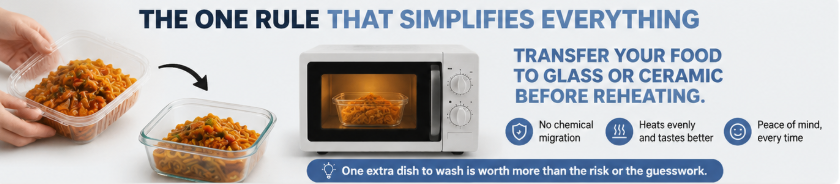
You can memorize numbers, avoid certain foods, check lids, and replace boxes every time—or you can adopt one habit that makes all of this irrelevant.
Transfer your food to glass or ceramic before reheating.
That's it. No symbols to decipher, no "but what if it's only 30 seconds?" debates. Glass and ceramic heat evenly, don't add any unwanted taste, and eliminate the entire question of chemical migration.
Yes, it means one extra dish to wash. But compare that to reading labels, remembering which number is which, and second-guessing every time you order from a new restaurant. The mental energy saved is worth the 30 seconds it takes to swap containers.
A Quick Recap for the Lazy (or Busy)
If you absolutely refuse to transfer food and insist on using the original box, here's the shortest version:
Only consider boxes with recycling number 5 or 2.
Remove the lid completely before heating.
Avoid reheating oily, greasy, or sugary dishes in plastic.
Keep microwave power at medium rather than high.
Heat in short intervals—just until food is warm enough to eat, not until it's bubbling.
And if you see foam, metal, or anything unmarked, don't even think about it.
The Bottom Line
The reality is that thousands of people microwave to-go boxes every single day without any immediate issue. But "I did it and I'm fine" is not a safety standard—it's just luck.
The industry has made progress. Many responsible to-go box manufacturers now clearly label their PP products and include explicit microwave instructions. Some custom to-go box suppliers have even developed microwave-optimized lines designed specifically for restaurant takeout. But not every restaurant sources from these premium vendors. Many still buy from budget to-go box distributors who prioritize cost over clarity.
This is why the smart approach is to treat microwavable claims as conditional, not absolute. If you're a regular takeout consumer, developing the glass-transfer habit will save you from needing to track which OEM to-go box producer made your box or whether the to-go box factory that supplied your local restaurant follows the same safety standards as a reputable to-go box wholesale provider.
And if you're someone who meal-preps or orders in bulk from a B2B foodservice supplier, consider this an invitation to ask your vendor directly about material composition and test results. The best disposable to-go box manufacturer will welcome those questions.
When in doubt, just use a plate. Your lunch will taste better, heat more evenly, and you'll never have to wonder whether you're eating microplastics with your noodles. That peace of mind is worth more than saving a few seconds.