Ask a plastic cup supplier whether a cup is recyclable and you will probably get a quick answer: yes.
That answer is not necessarily wrong. It is just not enough.
For a beverage company buying 50,000 or 500,000 cups, the more useful question comes a little later. What happens to those cups after customers finish their drinks? Can they actually go into the recycling system where the cups are sold, or does “recyclable” only describe the material used to make them?
That difference is easy to miss when comparing products on a quotation sheet.
The Material Is a Starting Point

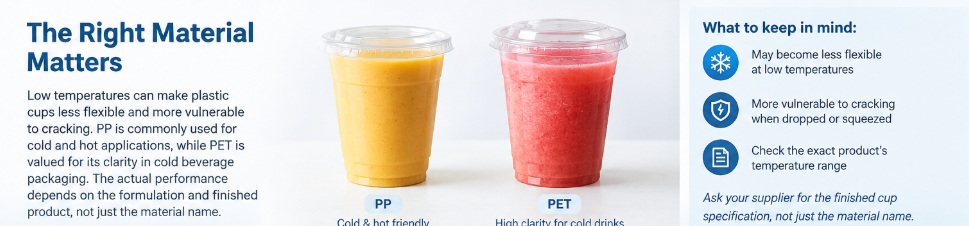
Most buyers will first look at the plastic itself, and that makes sense. PET and PP are both widely used for beverage packaging, but knowing the resin does not settle the recycling question.
Suppose a buyer is talking to a custom plastic cup manufacturer about a new iced coffee cup. The cup might be made from a recyclable resin. But what about the lid? Is it the same material? Is there a sleeve around the cup? Will the finished product carry a label or a printed coating?
These details usually do not appear in a simple product name such as “recyclable plastic cup.”
They should be part of the conversation before the order is finalized.
Look at the Cup as a Complete Package
A cup rarely reaches the customer by itself.
There is normally a lid. Sometimes there is a straw. A branded beverage may also have a sleeve, label, or other decoration. None of this automatically makes the package non-recyclable, but it does make the situation less straightforward.
This is one reason a buyer working with an OEM plastic cup supplier should ask for the material information for the whole cup set.
The cup may be PET while the lid is PP, for example. That does not give a simple yes-or-no answer about the entire package. What matters is how those components are handled in the recycling system serving the target market.
For a standard stock cup, this may be a minor detail. For a custom program running across several beverage stores, it is worth checking.
The Same Cup May Not Have the Same Answer Everywhere

This is probably the part that causes the most confusion.
A plastic cup can be recyclable in the material sense without being accepted by the recycling collection available to customers in a particular location.
Recycling programs are local. Their accepted materials and packaging formats are not identical from one city or region to another. Foodservice packaging can also be treated differently from household containers.
So if a plastic cup factory for beverage brands says, “This cup is recyclable,” ask one more question:
Recyclable where?
That question is much more useful than asking whether the cup has a recycling symbol. If a beverage company sells in several countries, the answer may need to be checked market by market.
It is also worth remembering that a resin identification code identifies the plastic. It does not, by itself, guarantee that the local collection program will take the finished cup.
The Cup Changes After It Has Been Used

There is another issue that looks small on a product specification but becomes very real in a busy café.
Think about an iced latte at the end of a customer's lunch break. The cup may still have milk or coffee around the bottom. A smoothie cup may have fruit residue inside. Some customers empty the cup before throwing it away. Others do not.
The factory cannot control that part.
A wholesale plastic cup manufacturer can control the resin, dimensions, wall thickness, forming quality, and consistency of production. It cannot control the condition of the cup ten minutes after the customer finishes the drink.
That matters because food residue can affect whether a local recycling program accepts the item and how it is processed.
For a business selling large volumes of takeaway drinks, this is a more practical concern than simply asking whether the cup material is technically recyclable.
Customization Can Add Another Question
A plain clear cup and a heavily branded cup are not necessarily identical at the end of their useful life.
A customer may want a logo printed across the entire surface. Another may prefer a full-body sleeve. A third may add labels to an otherwise standard cup.
When working with an ODM plastic cup supplier, it is worth discussing these choices before the artwork is approved. The question is not “Does printing make the cup unrecyclable?” That is too broad.
The better question is whether the selected printing, label, sleeve, coating, or adhesive is compatible with the recycling requirements of the intended market.
This is also where a supplier's experience becomes useful. A buyer may know exactly how they want the cup to look without knowing which decoration option creates fewer complications later.
What Should a Buyer Ask the Supplier?
There is no need for a long sustainability questionnaire.
Start with the basics. What plastic is used for the cup? What plastic is used for the lid? Are there coatings, sleeves, or other components? Then give the supplier the destination market and ask what their recyclability claim is actually based on.
A capable plastic cup manufacturer for foodservice companies should be able to answer those questions without hiding behind the word “eco-friendly.”
Documentation is useful too, particularly when the buyer plans to put an environmental claim on the product packaging or website.
This becomes even more important with private-label products. A private label plastic cup supplier may manufacture the cup, but the brand selling it is the one that ultimately has to stand behind what it tells its customers.
So, Are Plastic Cups Recyclable?
Some are. But that is not really the question a commercial buyer needs answered.
If you are sourcing cups for a beverage business, look beyond the resin. Check the lid. Check the decoration. Think about where the cups will be sold. Consider what condition they will be in after use. Then find out what the supplier means when they call the product recyclable.
A recyclable plastic cup supplier for beverage businesses should be able to discuss those points with you before production, not after the shipment has arrived.
In other words, recyclability is not just a property of the plastic cup sitting in the factory.
It is what happens to that cup once it leaves the factory.