If you are preparing smoothies, frozen desserts, drinks, fruit portions, or other food products in advance, you may wonder: can you put plastic cups in the freezer?
In many cases, yes. But “plastic” by itself does not tell you whether a cup is suitable for freezing. A cup that works well for a cold drink at room temperature may behave very differently after several hours in a commercial freezer.
For restaurants, food brands, distributors, and other buyers, the more useful question is not simply whether a plastic cup can freeze. It is whether the cup, lid, contents, filling level, and handling process will continue to work after freezing.
What Happens to a Plastic Cup in the Freezer?
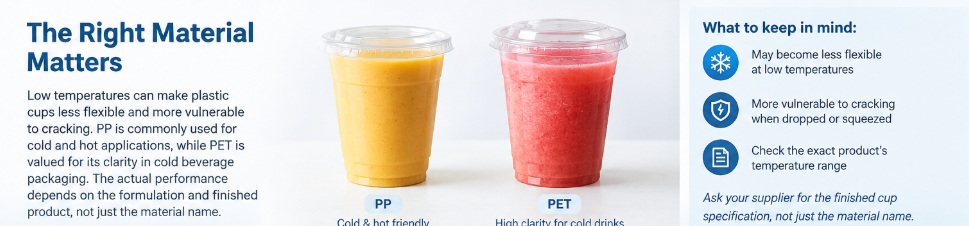
Low temperatures can change how a plastic cup behaves. Depending on the material and design, the cup may become less flexible and more vulnerable to cracking when it is dropped, squeezed, stacked, or handled roughly.
This matters because freezing is rarely an isolated step in commercial food packaging. A filled cup may go from production to a freezer, remain there for days or weeks, move through cold storage, and then be transported before reaching the customer.
Material selection is therefore important. PP is commonly used for applications involving both cold and hot conditions, while PET is valued for its clarity in cold beverage packaging. However, the actual performance depends on the formulation and finished product rather than the material name alone. Commercial packaging suppliers also publish different temperature ranges for specific cup products, which is why a specification for the exact cup is more useful than a generic material claim.
If you are sourcing freezer safe plastic cups from a wholesale supplier, ask about the finished cup rather than assuming every cup made from the same resin has identical performance.
The Cup May Be Fine, But What About the Lid?

The lid is one of the easiest parts of a frozen package to overlook.
A cup can remain intact while the lid becomes loose, cracks, or loses its seal. This becomes particularly important when the contents expand during freezing. If a cup is filled almost to the rim, the expanding contents can put additional pressure on the lid and container.
For this reason, businesses should evaluate the cup and lid together. A custom plastic cup manufacturer for food packaging should be able to discuss whether the selected lid is designed to work with the specific cup dimensions and intended application.
The question is not only whether the lid can physically fit. It should remain properly engaged after freezing, stacking, transportation, and thawing.
How Full Should a Plastic Cup Be Before Freezing?
Overfilling is a simple mistake that can create expensive problems.
Many liquids expand as they freeze. If there is almost no space between the contents and the lid, expansion has nowhere to go. The result may be a raised lid, deformation, leakage, or excessive stress around the cup rim.
The correct filling level depends on the product, cup geometry, lid design, and freezing conditions, so there is no universal fill percentage that works for every application.
A PP plastic cup manufacturer for frozen food applications can help evaluate the relationship between cup capacity and actual filling volume. For a new product, it is better to test the filled package using the recipe and filling process you will actually use instead of testing an empty cup.
Is a Home Freezer Test Enough?
Not necessarily.
A cup that survives a household freezer may still perform poorly in a commercial operation. Commercial freezers can involve faster temperature changes, larger quantities, tighter stacking, repeated handling, and transportation after freezing.
The difference becomes even more important for frozen products that are moved through a cold chain. Packaging may experience vibration, pressure from other packages, and repeated handling while the plastic is relatively cold and less forgiving.
If your application involves rapid freezing or particularly low temperatures, ask your OEM plastic cup supplier for commercial freezer applications about the intended temperature range and whether the specific product has been tested under comparable conditions.
Published manufacturer guidance also warns that general temperature recommendations are not a substitute for testing under a buyer's actual food, process, and supply-chain conditions.
What About Taking the Cup Out of the Freezer?
Freezing is only half of the story.
After storage, the package may be removed from the freezer and immediately handled, stacked, transported, or placed on display. This is where a cup that looked fine during storage can encounter problems.
A frozen cup may be more susceptible to impact. A lid that fitted correctly at one temperature may also behave differently as the package warms. Condensation can make handling more difficult, while repeated temperature changes can expose weaknesses in the cup or closure.
This is why a disposable plastic cup factory for frozen beverage packaging should consider the complete use cycle rather than only the minimum freezer temperature.
How Should You Test Plastic Cups Before a Bulk Order?

Before committing to a large production run, test the actual cup you intend to purchase.
Fill it with the actual product, use the intended lid, and place it under the same freezing conditions used in production. Check the package after freezing rather than judging it immediately after removal.
Look for cracks around the rim and sidewall, lid separation, leakage, deformation, and problems when cups are stacked. If the product will be transported while frozen, include transportation or handling conditions in the trial as well.
This approach is particularly important when working with an ODM plastic cup factory for customized packaging, because changing the dimensions, wall thickness, capacity, mold, or lid can change how the finished package performs.
What Should You Ask Your Plastic Cup Supplier?
A reliable supplier should be able to give you more than a simple “yes, freezer safe.”
Ask which material and finished specification are being recommended, what temperature range applies to that specific product, and whether the cup and lid have been evaluated together.
You should also discuss your filling volume, storage duration, stacking method, freezing process, and transportation conditions. If the cup will carry a specific food or beverage, explain that application rather than asking about the cup in isolation.
For buyers comparing suppliers, a custom cup and lid supplier for food brands can be more useful when it can discuss design changes and testing instead of simply offering an existing catalog item.
Food-contact compliance should also be considered separately from freezer performance. In the U.S., food-contact substances used in packaging must be authorized for their intended use, and FDA evaluates relevant safety information such as migration and toxicological data.
When Should You Consider a Custom Plastic Cup?
A standard cup may be enough for a straightforward frozen application. But customization becomes worthwhile when you encounter problems such as cracking, poor lid retention, insufficient headspace, weak stacking performance, or leakage after thawing.
In those situations, the solution may involve changing the material, wall structure, cup geometry, capacity, or lid rather than simply choosing a thicker cup.
An experienced plastic cup manufacturer for wholesale food packaging should be able to work through these requirements with you before production instead of leaving performance issues to be discovered after the order arrives.
The Bottom Line
So, can you put plastic cups in the freezer? Often yes, but the answer depends on the specific cup and how you intend to use it.
For commercial applications, freezer suitability should be evaluated as a complete packaging system: the cup, lid, contents, filling level, temperature, stacking, transportation, and thawing process all matter.
If you are buying thousands of cups rather than freezing one at home, the safest approach is simple: define the real operating conditions first, ask the OEM plastic cup supplier for a product-specific recommendation, and test the filled package before placing a large order.
That extra step can prevent a small packaging decision from becoming a large problem in storage, transportation, or customer delivery.