Paper cups and plastic cups are often compared as if one must be the better choice. In practice, buyers rarely make the decision that way.
A coffee shop may need a cup that feels comfortable when filled with hot coffee. A bubble tea business may care much more about seeing the drink through the cup. A distributor has another concern altogether: carton dimensions, freight, storage, MOQ, and whether the next shipment will match the last one.
The material is only the starting point. The better choice depends on what happens after the cups leave the factory.
The Drink Usually Makes the First Decision
Start with the beverage.
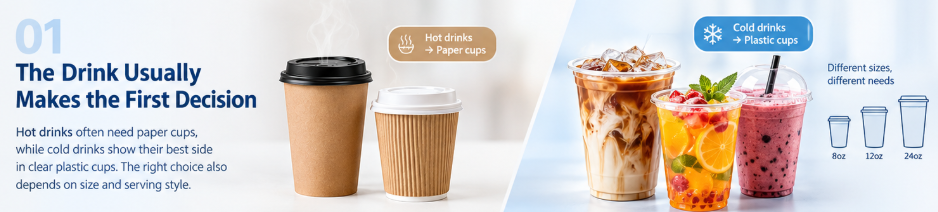
Hot coffee, tea, and similar drinks are commonly served in paper cups. The construction can be designed around hot beverage use, and insulated paper cup designs can reduce the amount of heat transferred to the outside wall.
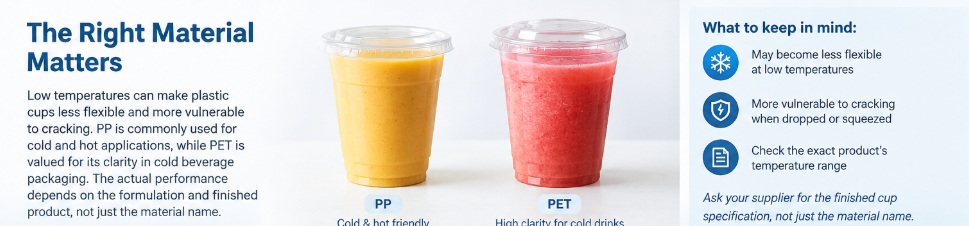
Cold beverages bring different requirements. When customers can see ice, fruit, coffee layers, toppings, or the color of a smoothie, a clear plastic cup can have an obvious advantage. The packaging does not hide the product.
This is one reason a custom paper cup manufacturer for coffee shops may be a natural fit for cafés, while a cold-drink operator may spend more time looking at clear plastic options.
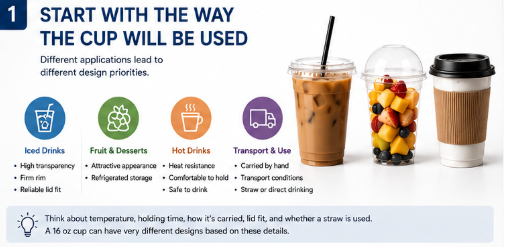
There is also the question of size. A cup that works well for a 12 oz coffee does not necessarily make sense for a large iced drink. Larger volumes put more pressure on wall strength, lid fit, handling, and transport.
A Lower Unit Price Can Be Misleading
The number on a quotation is usually the easiest part of the calculation.
The harder part comes afterward.
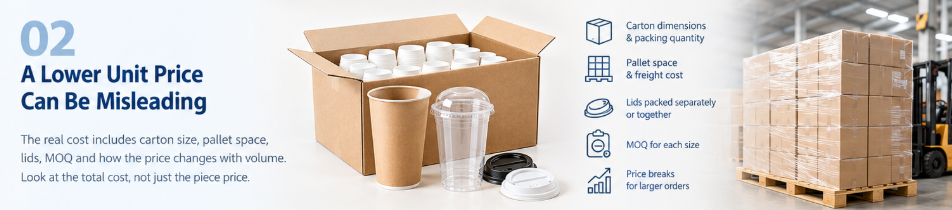
How many cups are packed in a carton? How much space does one pallet take? Are the lids packed separately? Does the supplier have a minimum order for each size? What happens to the price when the monthly order doubles?
These details can change the economics of the purchase.
For example, a cup with a slightly higher factory price may still work better if it has efficient carton packing and a readily available lid. On the other hand, a low-priced cup becomes less attractive if freight, extra packaging, or high damage rates eat into the difference.
A wholesale paper cup supplier for beverage businesses should be able to provide enough packing and pricing information for buyers to calculate the delivered cost, rather than leaving the comparison at the piece-price level.
The Lid Can Cause More Problems Than the Cup
This is easy to overlook when samples are being evaluated.
A cup can hold the drink without leaking and still perform badly in takeaway use if the lid does not fit securely. Staff may put hundreds of lids on cups during a busy shift, so a connection that requires too much pressure or does not lock consistently can become a daily nuisance.
Delivery makes the problem more obvious. Drinks move around in bags and vehicles. The cup may be perfectly sound, but a loose lid can still result in a spilled order.
Cup diameter, rim design, lid compatibility, and drinking openings are therefore worth checking together.
When dealing with a paper cup factory for takeaway packaging, it is better to test filled cups with their intended lids rather than approving the cup separately.
Paper Does Not Automatically Mean “More Sustainable”
This is probably the area where the comparison becomes too simplistic.
Paper cups still contain other components, and their actual environmental profile depends on the construction and what happens after use. Plastic cups are not all the same either. Material type, recycled content, local collection systems, and recycling infrastructure can all change the practical picture.
There is another issue for businesses selling internationally: requirements are not necessarily identical from one market to another.
A buyer supplying restaurants in one country may have very different packaging requirements from a distributor serving another region. Before putting an environmental claim on packaging, it is sensible to check what supporting documentation is available.
For companies sourcing sustainable paper cups for foodservice applications, the useful conversation with a supplier is about actual material composition, applicable standards, and market requirements—not simply whether the cup is described as “eco-friendly.”
Consider What You Want Customers to Notice

The cup can either carry the brand or show the drink.
Paper is useful when printed graphics are an important part of the presentation. Coffee shops can use the cup for logos, colors, seasonal campaigns, or other artwork. Someone carrying the drink through a shopping area is effectively carrying the brand with them.
Transparent plastic takes a different approach.
If the drink itself looks good, hiding it may not make much sense. Bright fruit drinks, iced coffee, layered beverages, smoothies, and drinks with visible toppings can benefit from a clear container.
That difference can affect the choice more than some technical specifications.
A printed paper cup supplier for branded beverage packaging may be a strong option for a coffee-focused brand. A business selling visually distinctive cold drinks may get more value from product visibility.
What Works for a Café May Not Work for a Distributor
Order volume changes the priorities.
A small café may want a few standard sizes and manageable MOQs. It may not have much warehouse space, and tying up cash in a large stock of printed cups may not be attractive.
A larger chain can approach the same purchase differently. It may order several sizes, require consistent printing across repeated production runs, and negotiate pricing based on a much larger annual volume.
A distributor has yet another concern. The product has to make sense after freight, warehousing, and resale margins are included.
That is why a private label paper cup manufacturer for beverage brands should be judged partly on repeat-order capability. A good first batch is useful, but distributors and established brands need consistency when the second, fifth, or tenth order arrives.
Look at the Whole Packaging Setup
The cup is only one part of the order.
There may be lids, sleeves, straws, inner bags, cartons, and pallets. If these items are purchased from different suppliers, the buyer also has to coordinate sizes and specifications between them.
Storage is another practical issue. A packaging item that looks inexpensive can become inconvenient when several truckloads need to be kept in a limited warehouse.
For a bulk paper cup manufacturer for restaurant supply, questions about carton packing, pallet loading, compatible lids, lead times, and repeat production can be just as important as the cup itself.
This becomes particularly noticeable when a business adds more drink sizes. What looked like a simple two-SKU purchase can quickly become six or eight combinations of cups and lids.
There Is No Single Winner
Paper cups make a lot of sense for hot beverages and brands that want the cup itself to carry printed graphics. Plastic cups can be particularly useful for cold drinks where customers expect to see what they are buying.
Neither option should be selected from the material name alone.
Look at the actual drink. Fill the cup. Put on the real lid. Leave it standing for the expected service period. Test it during transport if the product is delivered. Then look at the quotation again with freight, packing, MOQ, and storage included.
For businesses comparing an OEM paper cup supplier for wholesale beverage programs, that process will usually tell you more than a generic paper-versus-plastic comparison ever could.
The right cup is the one that works quietly in the background: it holds the drink, fits the lid, survives the journey, suits the brand, and can still be ordered at the same specification when you need the next shipment.