Start With the Order, Not the Math
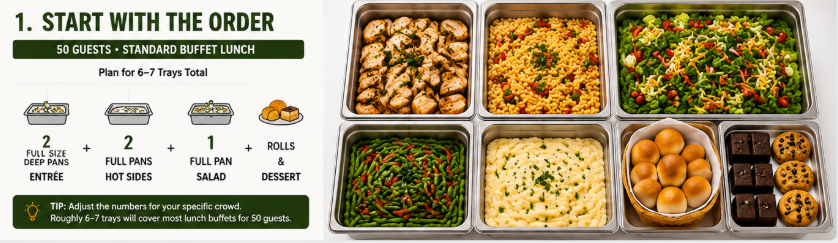
If you're staring at a catering menu right now, here's your answer: for 50 guests at a standard buffet lunch, you need roughly two full-size deep pans of entrée, two full pans of hot sides, one full pan of salad, plus rolls and dessert. That's about six to seven trays total. Point at those and you'll be fine. Everything below exists so you can adjust that number for your specific crowd instead of praying.
The Pan Size That Ruins More Parties Than Anything Else
Before you count anything, look at the depth of the tray you're being sold. A full-size pan is about 20 by 12 inches, and it comes in a shallow 2.5-inch version and a deep 4-inch version. The deep one holds nearly twice as much. I've watched a graduation party run out of brisket in eighteen minutes because the host ordered "four full trays" without asking, and got shallow ones. Same footprint on the table, half the food inside. When you're ordering, say the depth out loud. Any decent custom food trays manufacturer or catering desk will confirm it without hesitation, and if they can't, that's information too.
What 50 Guests Actually Eat
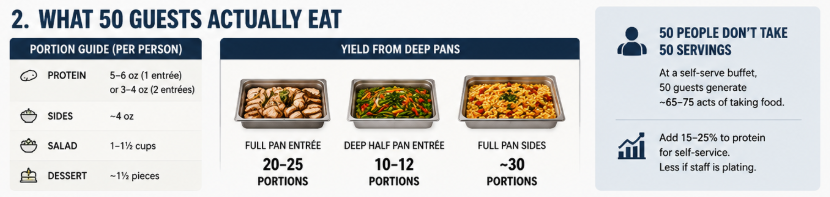
Portion planning gets easier once you stop thinking in trays and start thinking in ounces. Plan five to six ounces of protein per person if there's only one entrée, or three to four ounces each if you're offering two and people will take both. Sides run about four ounces. Salad is a cup to a cup and a half. Dessert works out to roughly one and a half pieces per guest, because someone always comes back for a second cookie.
Run that through 50 people and a deep full pan gives you around 20 to 25 entrée portions, a deep half pan gives 10 to 12, and a full pan of sides stretches to about 30. So a light afternoon reception for 50 is maybe 75 sandwich halves or wraps across three trays plus two pans of finger food. A standard lunch is the six-to-seven-tray setup above. A real dinner, evening, hungry people, four hours, pushes to three full pans of entrée and three of sides.
Fifty People Don't Take Fifty Servings
This is the part almost nobody tells you. At a self-serve buffet, 50 guests don't generate 50 servings of demand. They generate closer to 65 or 75 acts of taking food, because a third of the room comes back. Add 15 to 25 percent to your protein if guests are serving themselves, and less if staff is plating. That single adjustment is the difference between a table that looks generous at the end and a chafer with a sad puddle of sauce in it.
And yes, you should have leftovers. Something in the range of 10 to 15 percent remaining means you got it right. Zero leftovers means at least four people took a small polite portion because the pan looked empty.
Adjust for Who's Actually Coming
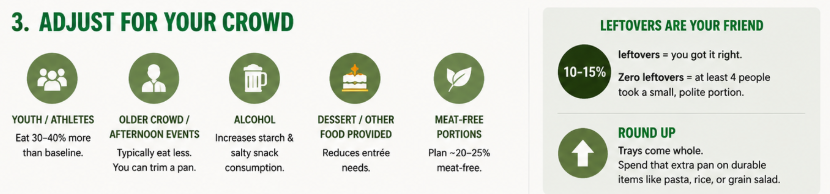
A youth sports banquet and a retirement luncheon are not the same 50 people. Teenagers and anyone who worked a shift beforehand will eat 30 to 40 percent more than your baseline. An older crowd, or a bridal shower running from two to four in the afternoon, typically eats noticeably less, and you can trim a pan. Alcohol pushes starch and salty snack consumption up. A big sheet cake or a few relatives bringing casseroles pulls your entrée count down. Plan roughly a fifth to a quarter of your portions as meat-free, not because it's trendy but because you'll get fewer panicked texts the night before.
Whatever the math says, round up. Trays only come whole. When you're forced to buy that extra pan, spend it on something durable like pasta, rice, or a grain salad rather than seafood, so it survives the afternoon and the drive home.
Trays, Chafers, and the Stuff Everyone Forgets
Food volume is only half the order. Every hot pan needs a chafing frame and two fuel cans if you're holding for two hours. You need a serving utensil for every single pan, not a shared spoon. If you're renting or reordering, this is where buyers start looking past the grocery aisle: a wholesale food tray factory ships in case quantities that cost a fraction per unit compared to a supermarket run, and venues that host weekly events almost always end up sourcing from an OEM food trays supplier for catering distributors rather than repurchasing retail. If your operation runs the same menu repeatedly, a private label tray manufacturer working with event caterers can match depths and lids to your standard portions, which quietly eliminates the shallow-pan problem forever.
The Day-Of Rhythm That Keeps the Line Full
Don't put every tray out at once. Set half your entrée on the line and hold the rest in the oven or a warmer, then swap the pan when it hits a third full. A fresh-looking pan slows people down; an empty-looking one makes them grab extra. Put salad and bread at the front of the line and protein last, or the first twenty guests will clear the meat. Keep hot food above 135°F and cold below 41°F, and don't let anything sit out past the two-hour mark. Have foil and takeaway containers ready before anyone asks.
If Sixty People Show Up
They will. Your recovery plan is three things you can add in twenty minutes: a bagged salad kit, a warm tray of pasta, and rolls. All three are cheap, all three are fast, and all three make the table look intentional. Operations that get caught short repeatedly usually solve it upstream by keeping a shelf of spare pans on hand, which is exactly why a bulk food trays supplier serving restaurant groups or a food tray factory offering direct pricing to volume buyers becomes part of the process rather than an afterthought. For caterers scaling up, an ODM disposable tray production partner can even tool sizes that match your recipe yields.
The Short Version
Six to seven trays for 50 guests at lunch, eight to ten for a full dinner, four to five for a light reception. Deep pans, not shallow. Add a quarter for self-service, round up, plan a fifth meat-free, and hold half your food back for the second wave. Procurement teams buying at scale should compare a custom catering tray supplier for large-volume purchasing against retail before committing, because the per-unit gap is usually significant. Order tomorrow, confirm your headcount two days out, and stop refreshing the RSVP list.