If you buy food packaging by the case, “rigid packaging” is not really a terminology problem. The bigger concern is whether a package will still do its job after filling, stacking, shipping, and repeated handling.
A rigid package keeps its shape instead of folding or collapsing like a pouch or film. Food containers, trays, bowls, cups, clamshells, and many takeaway boxes fall into this category. But simply calling something “rigid” does not tell you whether it is suitable for a particular product.
A thin container may hold its shape well enough on a retail shelf but buckle when stacked. Another container made from the same plastic may perform much better because its walls, corners, base, or rim have been designed differently.
That distinction is important when working with a rigid packaging manufacturer. The right package starts with how it will be used, not just the material written on the specification sheet.
What Makes Packaging Rigid?

There is no single thickness or hardness level that turns packaging into rigid packaging.
In practical terms, the package needs to retain its intended shape during normal use. Material is part of that equation, but so are wall thickness and overall design. A reinforced sidewall, stronger rim, or carefully shaped base can make a noticeable difference without simply adding more material everywhere.
This is why buyers should describe the application when discussing a new package. A container for chilled salad has different requirements from one intended for hot takeaway food. A tray going directly onto a supermarket shelf has a different job from one travelling through a distributor's warehouse.
A good rigid plastic packaging supplier should be able to work through those differences before recommending a specification.
Rigid vs. Flexible Packaging

The difference becomes easier to understand when looking at what happens after the package leaves the factory.
Flexible packaging is convenient when low weight and compact storage are priorities. It can be folded or rolled before use, which makes transportation and storage relatively efficient.
Rigid packaging gives the food a defined space. That can be useful when the product needs protection from crushing or when its appearance matters after transportation.
Think about a bakery item, fresh produce, prepared meal, or salad. If the package collapses easily, the food inside may arrive damaged even though the packaging itself has not been punctured.
For this reason, buyers comparing packaging options should look at more than material cost. Stacking, lid fit, empty-unit nesting, carton size, and transport conditions can have just as much influence on the final cost.
Why Food Businesses Choose Rigid Packaging
Protection Is Often the First Reason
Commercial packaging can be handled dozens of times before a customer sees it. It may be filled, closed, stacked into cases, moved around a warehouse, loaded onto a truck, and unloaded again.
A rigid structure can help the package withstand this routine handling without losing its basic shape. That does not mean every rigid container is heavy-duty. Design still matters, and an unnecessarily thick container may simply add cost and shipping weight.
An experienced food rigid packaging factory should therefore look at the expected load and handling conditions rather than assuming that more plastic automatically means better performance.
Stacking Can Affect the Whole Supply Chain
A single container may look perfectly fine during a sample review. The situation changes when a buyer orders tens of thousands of pieces.
Empty containers need to be nested and packed efficiently. Once filled, they need to stack without slipping, collapsing, or putting excessive pressure on the food. Poor geometry can also waste carton and pallet space.
For distributors and large foodservice operations, these details matter because packaging takes up warehouse space and freight capacity long before it reaches the end customer.
Product Appearance Matters Too
Some food products are sold partly through their appearance. Clear rigid packaging can let customers see the contents while keeping the package itself intact.
This is common with salads, fresh produce, bakery items, prepared meals, and other ready-to-eat foods. The package does not need to make the product look better; it simply needs to avoid making it look worse.
When standard dimensions do not work, a custom rigid food packaging supplier can develop different depths, compartment layouts, closures, or dimensions around the product.
Which Materials Are Used?

Material selection should follow the application rather than the other way around.
PET is often considered when clear product visibility is important. It is widely used for cold food, bakery products, fresh produce, and retail applications where seeing the contents is part of the buying experience.
PP becomes more relevant when temperature is a concern. Many food containers use PP for hot food or reheating applications, although the actual temperature performance depends on the grade, design, and intended use.
CPET is another option for applications requiring higher-temperature performance, including some prepared-meal formats.
rPET may be considered when recycled content is part of the purchasing specification. Buyers still need to check the actual recycled content, food-contact requirements, appearance, and supply consistency rather than assuming every rPET product has the same characteristics.
PLA and other alternative materials can also be used in certain rigid packaging applications. Their suitability depends heavily on temperature, product conditions, certification, and the waste-management system available in the target market.
A capable OEM rigid packaging factory should be able to explain these differences in the context of the product rather than simply presenting a material catalogue.
How Do You Choose the Right Rigid Package?
Start with the food.
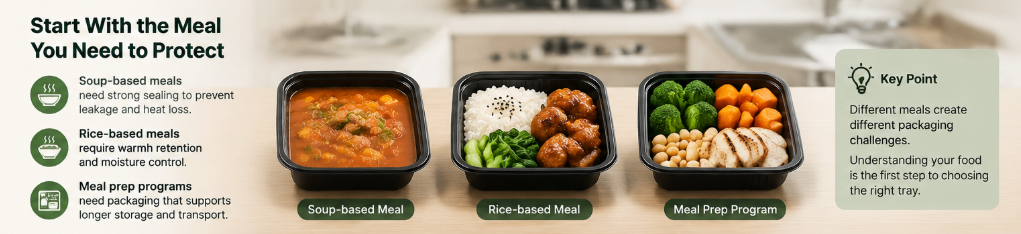
Is it hot or chilled? Does it contain oil or liquid? Is it frozen? How heavy is the portion? Does it need to be reheated? These questions narrow down the material and structural requirements surprisingly quickly.
Then look at what happens after filling.
A package that will be stacked for several hours in a restaurant has a different requirement from one that will travel thousands of kilometres before reaching a supermarket. Transportation vibration, stacking pressure, temperature changes, and repeated handling can all expose weaknesses that are not obvious from a single sample.
Logistics should be considered at the same time. Empty containers need to fit efficiently into cartons. Nested products should not be unnecessarily difficult to separate. Filled packages should remain stable during shipment.
For this reason, a rigid food container manufacturer for bulk orders will usually need to know how the packaging will be stored, transported, and used before confirming the final specification.
Rigid Packaging Is Not Automatically the Best Choice
Rigid packaging solves certain problems, but it can create others.
A rigid container may offer better protection while taking up more space. A thicker wall may improve strength while increasing material cost. A complicated shape may look attractive but nest poorly during transportation.
This is particularly important for large-volume buyers. A difference of only a few millimetres can become significant when thousands of containers are packed into cartons and loaded onto pallets.
The useful question is therefore not whether rigid packaging is “better” than flexible packaging. It is whether the additional structure provides enough value for the application to justify its cost and logistics impact.
What Should Buyers Ask a Supplier?
Before approving a large order, buyers should discuss the details that affect actual use: material grade, dimensions, wall thickness, tolerances, lid fit, temperature requirements, stacking performance, food-contact compliance, and production consistency.
Repeatability deserves particular attention.
A supplier may produce an excellent sample, but commercial packaging is purchased repeatedly. If the second or third production run has different dimensions or a less consistent lid fit, the original sample means very little.
A rigid packaging supplier for foodservice distributors should therefore be assessed on production control and repeat-order consistency as well as price.
For products with unusual dimensions, special compartments, or specific equipment requirements, custom tooling may also be worthwhile. An experienced custom rigid packaging factory for OEM projects can develop the package around the product instead of forcing the product into a standard container.
The Practical Way to Look at Rigid Packaging
Rigid packaging is not simply plastic that happens to be hard.
Its value comes from keeping the product protected and the package functional through the stages that matter to the buyer: filling, closing, stacking, storage, transportation, display, and final use.
Material is only one part of the decision. The food determines the operating conditions, the structure determines how the package handles those conditions, and logistics determine whether the solution remains practical at commercial volumes.
That is why choosing a rigid packaging manufacturer for commercial food applications should involve more than comparing sample prices. The better supplier is the one that can connect material, structure, manufacturing, compliance, and repeat supply into a package that works beyond the first order.