When sourcing food packaging for high-volume commercial operations, most buyers naturally focus on material specifications, visual appeal, and per-unit cost. These factors matter, but they only tell part of the story. The production method behind the package often determines whether that container actually performs across your entire supply chain—from filling lines to delivery vehicles to the customer's hands.
For restaurant groups, food brands, and distribution networks that order packaging by the truckload, batch-to-batch consistency matters just as much as aesthetics. A container that looks flawless in a sample box can still cause headaches at scale—stacking failures, dimensional drift, lids that won't snap, or material waste that eats into margins.
This is exactly where thermoforming technology proves its worth in modern food packaging production. It combines efficient high-volume manufacturing with design flexibility, helping businesses deliver packaging that satisfies both performance benchmarks and budget constraints.
What Makes Thermoforming Relevant for Packaging Buyers
Thermoforming dominates the production of food trays, portion cups, clamshells, and container bases because it offers distinct advantages for large runs. Compared to alternative manufacturing routes, it yields lightweight yet structurally sound packaging while keeping per-unit production economics attractive.
But for companies procuring at scale, the headline benefit isn't production speed. It's process repeatability.
An established thermoforming food packaging manufacturer maintains tight dimensional tolerances order after order, helping customers sidestep headaches on automated filling equipment, during palletizing, and at retail displays. This becomes critical for food operators who place recurring monthly orders or run high-speed packing lines.
Consider a quick-service chain ordering half a million takeout containers. Every batch must match the previous one in thickness, flange flatness, and cavity depth. Even minor deviations can compromise lid fit, stacking stability during delivery, or the customer's unboxing experience.
How Thermoforming Works at Production Scale
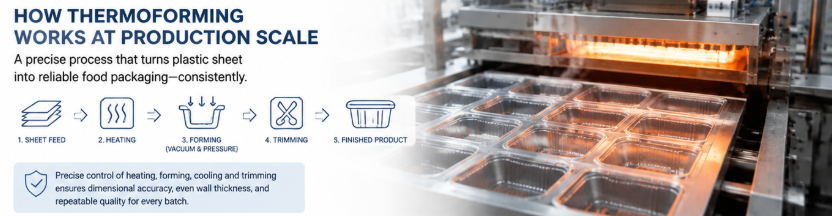
The manufacturing sequence begins with plastic sheet fed through heating elements until pliable. The softened material then gets drawn over or into molds using vacuum and pressure, followed by trimming to final shape.
The basic principle sounds straightforward, but commercial-scale production demands meticulous oversight of heating profiles, forming force, cooling rates, and material draw behavior.
Wall thickness inevitably shifts across different zones of the formed part. Skilled operators manage these variations to ensure critical regions—corners, sealing flanges, and load-bearing edges—retain adequate structural integrity.
For buyers seeking dependable supply, partnering with a qualified custom thermoformed food packaging factory reduces downstream risk. A competent production partner understands precisely how material selection, tool geometry, and process parameters interact to influence final part performance.
The objective isn't simply producing a container. It's producing packaging that behaves predictably from the moment it leaves the production floor through to the end-user's first interaction.
Selecting the Right Material for Your Application
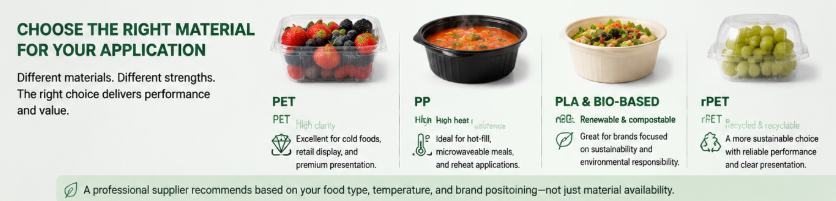
Material choice ranks among the most consequential decisions in any thermoformed packaging initiative. Different resin families offer distinct performance profiles.
PET remains the go-to for applications demanding optical clarity—berry punnets, pastry windows, and premium retail display packs. Its transparency showcases the product while delivering adequate stiffness for shelf presentation.
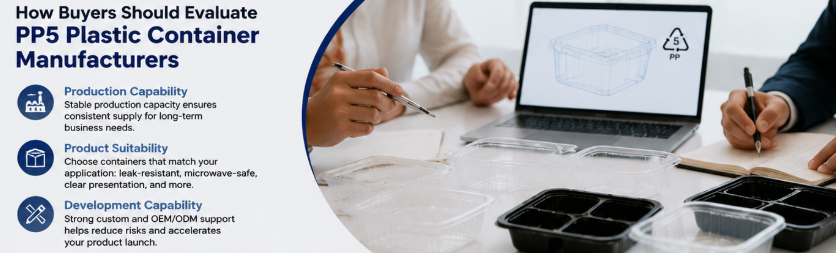
PP excels in hot-fill and reheat scenarios, offering superior thermal resistance. It's the standard for microwaveable meal bases, soup cups, and catering containers where temperature performance cannot be compromised.
PLA and other bio-based options are gaining traction among brands prioritizing environmental messaging. However, buyers should look beyond marketing claims. Certification authenticity, supply security, and actual use-case validation deserve equal scrutiny.
A professional OEM thermoforming food packaging supplier should present multiple material pathways and recommend based on your specific product characteristics—not simply push whichever resin they have in stock.
Design Elements That Drive Real-World Performance
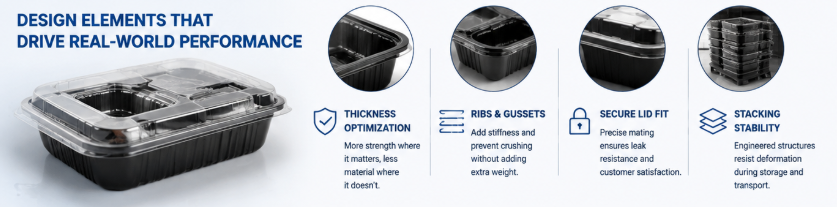
Material is only one variable. Structural geometry often determines whether a package succeeds or fails in practice.
Wall thickness profiling deserves particular attention. Simply making every section thicker boosts strength but raises material consumption and shipping weight. Savvy designers concentrate thickness where it's needed most—corners, stacking surfaces, and sealing perimeters—while thinning non-critical areas to reduce cost.
Ribbing and gussets add stiffness without substantial material penalty. Well-placed reinforcements prevent telescoping during pallet stacking and resist crushing in transit.
For lidded containers, fit precision is non-negotiable. Poor mating between base and lid invites leakage, compromises shelf life, and generates consumer complaints—all of which erode brand equity.
This explains why many operators prefer working with a thermoformed packaging manufacturer for food brands that offers engineering support from initial concept through tool validation and production ramp-up.
Thermoforming Versus Alternative Manufacturing Routes
Thermoforming isn't the only pathway to plastic packaging. Injection molding handles different requirements.
Thermoforming generally suits larger, shallower, or lightweight items—trays, bowls, and two-piece hinged containers. It typically delivers better material efficiency and shorter cycle times for these geometries.
Injection molding shines for parts requiring intricate features, thicker cross-sections, or highly detailed surface textures.
The optimal choice hinges on part size, annual volume, design complexity, and total landed cost. For the majority of food containers, thermoforming offers the most practical equilibrium between performance and per-unit economics.
Production Pitfalls That Buyers Should Anticipate
Even well-run thermoforming operations face quality challenges.
Thickness variation is persistent. If material distribution isn't tightly controlled, weak spots emerge that compromise drop-impact resistance or flexural strength.
Warpage arises from uneven cooling. Distorted parts create stacking instability and jams in automated denesting or filling equipment.
Component mismatch occurs when trays and lids are developed independently. Dimensional incompatibility leads to seal failures and frustrated end-users.
Engaging a qualified ODM thermoformed food packaging supplier helps mitigate these risks, since established suppliers typically possess deeper toolmaking expertise and more rigorous in-process inspection protocols.
Supplier Evaluation Criteria Beyond Price
Before committing to a large-volume contract, buyers should assess more than quoted unit pricing.
Production capacity is foundational. Does the supplier operate sufficient forming lines to accommodate your peak demand? Have they handled projects of similar scale?
Quality infrastructure matters equally. How does the supplier monitor incoming resin, in-process dimensions, thickness profiles, and food-contact safety compliance?
Design and engineering capability becomes crucial for brands requiring differentiated packaging. Suppliers with strong technical teams can help optimize structures, reduce overpackaging, and compress development timelines.
Aligning with a dependable bulk thermoformed food packaging supplier enables a resilient sourcing relationship—one that reduces the need to constantly re-qualify alternate vendors.
Practical Questions Before Finalizing Your Order
Before signing a purchase agreement, confirm these essentials:
Does the supplier offer material grades appropriate for your specific food type—including temperature, grease, and moisture resistance?
Can they demonstrate statistical process control data showing dimensional consistency across previous large-scale orders?
Do they have proven experience developing custom tooling and launching new packaging configurations?
Can they guarantee spec-to-spec repeatability for replenishment orders over multiple years?
These inquiries separate suppliers that deliver long-term value from those competing solely on first-order pricing.
Thermoforming Delivers Value Beyond the Production Floor
For food packaging buyers, thermoforming technology isn't merely a manufacturing abstraction. It directly influences package reliability, production line efficiency, and supply chain predictability.
The right manufacturing partner should demonstrate command of materials, process controls, and commercial realities. Whether your priority is elevating product presentation, trimming total system cost, or launching a proprietary packaging format, choosing an experienced thermoforming food packaging factory can materially affect outcomes.
A successful packaging program depends on the interplay of suitable materials, disciplined manufacturing, and capable supplier support. For businesses sourcing food packaging at commercial volumes, these factors consistently outweigh narrow price advantages in determining total value delivered.