A paper plate might cost only a few cents. A dishwasher can clean dozens of plates in one run.
So which one saves more money?
The answer gets less obvious once you run the numbers properly.
If you are comparing the price of one paper plate with the electricity used by one dishwasher cycle, you are leaving out some of the biggest costs. Someone has to buy and store the plates. Someone has to deal with the used ones. A dishwasher needs water, detergent, electricity, maintenance, and usually someone's time.
For a home, those differences may be small. For a restaurant serving hundreds of meals every day, they can become a surprisingly large part of the operating budget.
The Number Worth Comparing Is Cost Per Meal
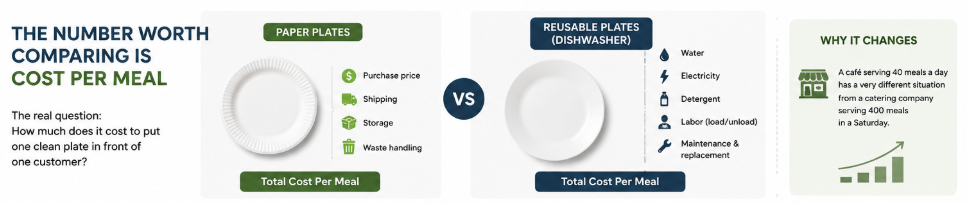
The easiest way to make the comparison useful is to forget the price of the equipment for a moment.
Ask a different question:
How much does it cost to put one clean plate in front of one customer?
With disposable plates, the calculation is fairly direct. You have the purchase price, shipping, and whatever it costs to handle the waste afterward.
With reusable plates, the cost is spread over many uses. Water and electricity are consumed every time the machine runs. Detergent is used. The dishwasher itself eventually needs maintenance or replacement. There may also be an employee spending time loading and unloading it.
That is why the answer can change dramatically from one business to another.
A café that serves 40 meals a day has a very different situation from a catering company serving 400 meals on a Saturday.
For a buyer working with a paper plates manufacturer for bulk supply, the delivered plate price is only the starting point. The number that matters is what those plates cost once they arrive, are used, and are thrown away.
Paper Plates Save More Than Washing Time
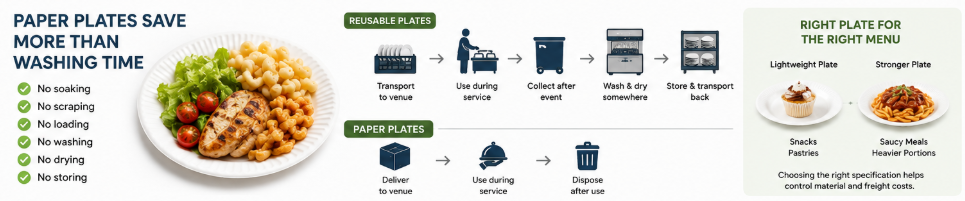
The obvious advantage of paper plates is the lack of a washing step.
After the customer finishes eating, the plate is gone. There is no soaking, scraping, loading, washing, drying, or putting it back on a shelf.
That sounds like a convenience issue, but in foodservice it can become a labor issue.
Consider a catering business setting up for a 200-person event. Reusable plates have to be transported to the venue, handled during service, collected afterward, and washed somewhere. If the event is held in a location without suitable dishwashing facilities, the logistics become even more complicated.
With disposable plates, much of that process disappears.
A custom paper plates supplier can also produce different sizes and specifications for different menus. A light plate may be enough for pastries or snacks, while a stronger option is more suitable for saucy meals or heavier portions.
That matters when ordering by the carton or pallet. Buying a plate that is unnecessarily heavy can quietly increase material and freight costs across a large order.
Of course, the plate doesn't disappear completely.
It becomes waste.
The Waste Bill Is Part of the Price
This is where disposable tableware can lose some of its advantage.
A business using 2,000 plates a day isn't simply buying 2,000 plates. It is also creating 2,000 pieces of used packaging that need to be collected and removed.
The actual cost depends heavily on the local waste system.
A small business may barely notice the difference. A large foodservice operation may have regular commercial waste charges, more frequent collections, and higher consumption of garbage bags.
Storage works in both directions, too.
Unused plates need warehouse space. Used plates need waste storage. If a buyer imports large quantities, carton size and pallet configuration can affect how much space the product occupies before it ever reaches the customer.
A wholesale paper plates supplier should therefore be evaluated on more than the unit quotation. Case quantity, packing efficiency, shipping volume, and order frequency can all affect the final landed cost.
A Dishwasher Is Not a $0.10 Cycle

Dishwasher calculations often look cleaner on paper than they are in real life.
You take the energy consumption, add water, and get a figure for one cycle.
But the machine doesn't load itself.
Food residue has to be removed. Plates have to be arranged. Detergent needs to be added. Once the cycle finishes, everything has to be unloaded and stored.
In a restaurant, those minutes belong to someone on the payroll.
There is also the machine itself. A commercial dishwasher represents an upfront investment, followed by maintenance and eventual replacement.
For a business that already owns the equipment, some of that cost is sunk. For a new operation, it should be included.
This is one reason a commercial paper plate supplier may be attractive even when a business already has a dishwasher. The question isn't whether the machine can wash the plates. It is whether washing every plate is actually the cheapest way to run the operation.
Half-Empty Dishwashers Are a Different Story
Here is a situation that often gets missed in online comparisons.
Imagine a dishwasher designed to clean 80 plates per cycle. You have only 25 dirty plates tonight.
The machine still runs.
You don't suddenly use one-third of the electricity and one-third of the detergent simply because the racks are mostly empty. The exact consumption varies by machine and cycle, but the basic problem remains: low utilization pushes the cost per plate upward.
This is particularly relevant to small offices, cafés with uneven traffic, and households.
A restaurant that fills the machine several times a day has a much better opportunity to spread the cycle cost across a large number of plates.
A business that regularly runs small loads may not.
That is one of the situations where disposable plates can look much more competitive than expected.
Labor Can Tip the Calculation
Let's say an employee earns $18 per hour.
If handling dishes takes 30 minutes a day, that is already $9 of labor before considering water, electricity, detergent, or equipment costs.
Over a month, the number becomes meaningful.
That doesn't mean paper plates will always be cheaper. A high-volume restaurant may already have employees assigned to dishwashing, and its equipment may be operating close to full capacity. In that environment, switching to disposable plates could simply replace one existing expense with another.
But for a small operation where employees are doing several jobs at once, removing dishwashing from the workflow may have a much bigger financial impact.
This is why a paper plates factory for foodservice applications is not competing against a dishwasher on product price alone. It is competing against the entire process required to get reusable tableware ready again.
Where Paper Plates Usually Make Sense
Disposable plates have a particularly strong case when usage is temporary or difficult to predict.
Think about a wedding reception, outdoor food stall, company event, festival, or catering job. The operator may need several hundred plates for one day and then have very little use for them afterward.
Buying and maintaining enough reusable tableware for that kind of demand may not make sense.
The same applies when washing capacity is limited. If adding more meals means adding another dishwasher, another employee, or another cleaning shift, the economics can move toward disposables.
A bulk paper plates supplier for catering operations can also be useful when the buyer needs a specific quantity for a particular event rather than maintaining permanent inventory of reusable tableware.
Where Reusable Plates Usually Win
The picture changes when the same plates are being used every day.
A restaurant serving 300 or 500 meals daily can run its dishwasher at a much higher utilization rate than a small office. The initial equipment cost is spread over a large number of meals, and the same plates can be used repeatedly.
If the dishwasher is already installed, fully loaded, and handled by staff who are already part of the kitchen operation, the additional cost of each washing cycle can be relatively low.
In that situation, replacing reusable plates with disposables means taking on a recurring purchasing and waste bill.
A paper plates manufacturer for restaurant supply should therefore be careful about presenting disposable plates as universally cheaper. They are not. The economics depend heavily on how the customer's kitchen actually operates.
Find Your Break-Even Point
There is a more useful way to answer the question than choosing a universal winner.
Work out your own break-even point.
Suppose your delivered paper plate cost is $0.12. Add $0.03 for waste handling and the disposable option is roughly $0.15 per meal.
Now suppose a dishwasher cycle costs $8 in utilities and detergent and handles 80 plates. That's $0.10 per plate before labor, maintenance, and equipment costs.
At first glance, the dishwasher wins.
But add $3 of labor to that cycle and the figure becomes $11, or about $0.14 per plate. Add equipment depreciation and maintenance, and the gap may disappear altogether.
These numbers are only examples. Actual costs vary by equipment, location, utility rates, plate specifications, and labor.
The useful part is the method.
A paper plates supplier for high-volume buyers can then be compared against the customer's real operating cost rather than a generic internet estimate.
So, Is It Cheaper to Use Paper Plates or a Dishwasher?
There isn't one answer for every situation.
If you run a large restaurant with an efficient commercial dishwasher, high plate turnover, and established kitchen staff, reusable plates will often be the cheaper long-term option.
If you run occasional events, catering jobs, outdoor foodservice, or a small operation with inconsistent demand, paper plates can make more financial sense.
The biggest mistake is treating the plate price or dishwasher electricity cost as the whole story.
Look at the complete operation.
How many meals are served? How full is the dishwasher? What does labor cost? How much does waste collection cost? Are the plates being transported or stored for long periods? Do you already own the dishwasher?
Once those questions are answered, the choice becomes much less theoretical.
For buyers purchasing disposable tableware at commercial volumes, a OEM paper plates supplier for wholesale distribution can help optimize the other side of the equation through bulk pricing, packaging configuration, and specifications matched to the actual food being served.
In the end, the cheapest option isn't necessarily the one with the lowest unit price.
It is the one that costs less to get through the entire meal—from serving the food to clearing the table and getting ready for the next customer.