For a foodservice business, ordering paper plates in bulk is not just a routine purchase. A decision that looks simple on a quotation sheet can affect daily operations, food presentation, customer experience, and even supply planning.
Many buyers compare paper plates by unit price first. It makes sense because price is visible and easy to measure. However, problems usually appear after the products are put into real use. Some plates lose their shape under heavy meals, some become weak after contact with sauces, and some suppliers cannot maintain the same quality when order quantities increase.
The better approach is to look beyond the product itself. A suitable paper plate should match the food application, working environment, and supply requirements of the business.
Start With Your Actual Food Service Scenario
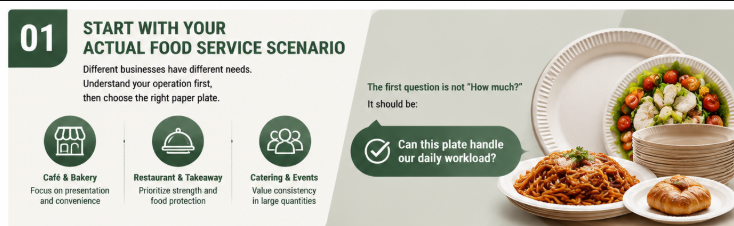
Before contacting suppliers, buyers should first understand what role the paper plates will play in their operation.
A café serving pastries has different needs from a restaurant providing hot meals. A catering company handling large events faces different challenges compared with a distributor supplying multiple food businesses.
For takeaway operations, plate strength is often a priority. Food may stay on the plate during preparation, packing, and delivery. If the plate becomes soft or loses stability, the problem is not only about the packaging itself but also about the overall customer experience.
Catering companies usually pay more attention to consistency. When thousands of plates are needed for an event, differences in size, thickness, or appearance can create unnecessary issues.
This is why many businesses choose to cooperate with a paper plates manufacturer for foodservice applications instead of simply purchasing general products from the market. A professional supplier can better understand different usage conditions and recommend suitable specifications.
The first question during purchasing should not be “How much does it cost?” It should be “Can this plate handle our daily workload?”
Match Plate Structure With Food Characteristics
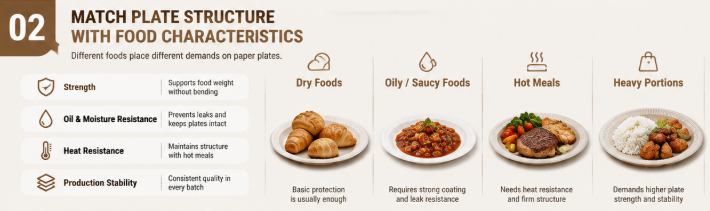
Different foods create different demands on paper plates.
Dry products such as bread, snacks, and desserts normally require less protection. However, meals containing oil, sauces, or moisture need stronger performance because liquids can quickly affect paper strength.
In many cases, buyers focus too much on whether a product looks thick enough or whether it has an attractive appearance. These factors do not always represent actual performance.
A restaurant serving hot meals may need better heat resistance and structural strength. A catering supplier may need plates that remain stable when stacked and transported. A distributor may focus more on consistency because one product may be supplied to many different customers.
An experienced OEM paper plates supplier for restaurant chains usually evaluates the complete usage environment before recommending a product. The supplier should understand food type, serving time, storage conditions, and expected order volume.
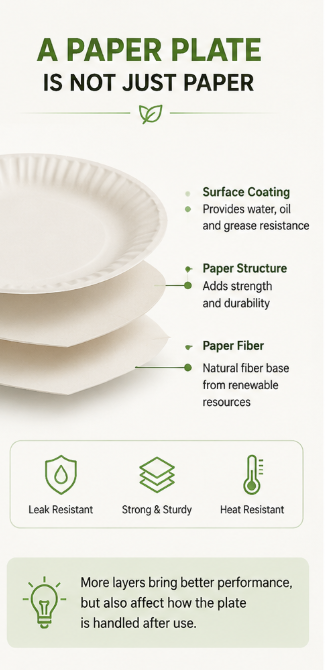
Important factors to review include paper weight, coating performance, resistance to oil and moisture, and production stability.
The right material choice is not about selecting the most advanced option. It is about choosing the one that fits the actual application.
Select The Size According To Business Needs
Size is another factor that can influence purchasing efficiency.
A larger paper plate may appear more convenient, but it also means higher material consumption, more storage space, and potentially higher shipping costs. The most suitable size depends on portion requirements and serving methods.
Small plates are often used for snacks, desserts, or samples. Medium sizes are common for individual meals. Larger plates are usually selected for catering, buffets, or food events.
However, size alone does not determine usability. The plate design, edge strength, and stacking ability also affect daily handling.
For businesses operating multiple locations, consistency is especially important. A small difference in dimensions may create difficulties in storage, packaging, or service procedures.
Working with a custom paper plates supplier for commercial orders allows buyers to adjust specifications according to their own requirements instead of adapting their operation to standard products.
Before placing a large order, testing the product with actual food portions is always more valuable than checking measurements only on paper.
Test Before Committing To Large Quantities
Bulk orders increase both opportunity and risk. A small problem with a sample can become a major cost issue when multiplied across thousands of units.
Professional buyers usually evaluate samples under real working conditions.
For example, a plate should be tested with the type of food it will actually hold. A product that performs well with dry food may behave differently with hot meals or oily dishes.
Strength is one of the first things to check. The plate should support the expected food weight without bending excessively.
Moisture and grease resistance are equally important. If the surface becomes weak after contact with sauces or oil, the product may not be suitable for commercial use.
Temperature conditions should also be considered. Businesses serving freshly prepared meals need different performance compared with companies using plates mainly for cold food or short-term applications.
A reliable disposable paper plates manufacturer for bulk supply understands that product testing is part of the purchasing process, not an unnecessary extra step.
Look At Supplier Capability Beyond Samples
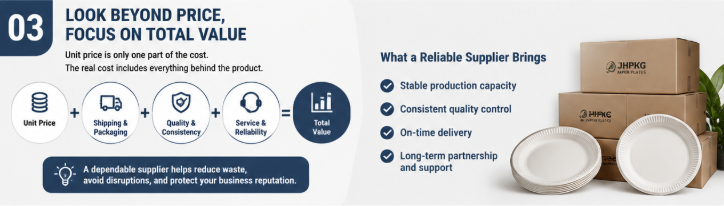
A good sample does not automatically mean a reliable long-term supplier.
For bulk orders, production ability becomes just as important as product quality. A supplier must be able to maintain consistent output when order quantities increase.
Before cooperation, buyers should understand several areas:
Can the supplier handle regular large-volume orders?
Can product quality remain stable between different production batches?
Can delivery schedules be maintained during busy periods?
These questions are especially important for distributors and foodservice companies that depend on continuous supply.
Quality control also deserves attention. A professional manufacturer should have procedures for checking raw materials, monitoring production, and inspecting finished products.
A capable paper plates factory for wholesale distribution should provide more than a competitive quotation. It should provide confidence that future orders will meet the same expectations.
Calculate The Real Cost Of Bulk Purchasing
Price comparison is unavoidable, but unit price does not represent the complete cost.
A cheaper paper plate may create additional expenses if it leads to higher waste, poor performance, or customer complaints.
For example, replacing damaged products or dealing with inconsistent quality can cost more than choosing a slightly higher-priced option from the beginning.
Other factors also influence total cost, including packaging efficiency, transportation requirements, and delivery reliability.
Experienced buyers usually consider the overall value instead of selecting the lowest offer.
A dependable bulk paper plates supplier for catering businesses helps companies control costs by reducing unexpected problems throughout the purchasing cycle.
Consider Customization When Building Long-Term Supply
As food businesses expand, many companies require more than standard paper plates.
Restaurant groups may need consistent designs across locations. Distributors may require specific packing quantities for different customers. Catering companies may need products adapted to particular events.
Customization can include sizes, packaging formats, or private label options.
A professional OEM paper plates factory for private label projects can support these requirements while maintaining production stability.
However, customization should have a clear purpose. The goal is not to add unnecessary features but to create products that better support business operations.
Final Thoughts
Choosing paper plates for bulk food service orders is a purchasing decision connected with daily efficiency and long-term supply management.
The right product should match the food application, perform consistently during use, and come from a supplier that can support future demand.
Instead of focusing only on the lowest price, businesses should evaluate product performance, manufacturing capability, and total operating value.
A reliable paper plates supplier for international foodservice markets can help companies reduce purchasing risks and build a more stable supply chain.