Ordering a plastic cup sounds easy until the cup needs to be made specifically for your brand.
A buyer may start with a simple idea: a 16 oz cup, a certain shape, a printed logo, and a matching lid. But once that idea reaches the factory, a lot more questions come up. How wide should the opening be? How heavy should the cup feel? Which material makes sense? Does the existing mold work, or is a new one worth the cost?
These decisions can affect the cup's appearance, performance, production cost, and even whether the finished product works with its lid.
For that reason, a custom cup project should be treated as a product development job, not simply a printing order.
Start With the Way the Cup Will Be Used
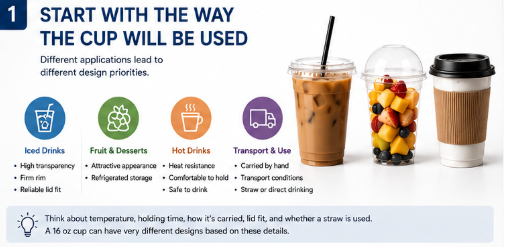
The best place to start is not the material or the mold. It is the actual application.
A cup used for iced coffee may need good transparency, a firm rim, and a reliable lid fit. A cup for fruit or desserts may place more emphasis on appearance and refrigerated storage. A cup intended for hot drinks has a very different set of requirements.
This information gives a custom plastic cup manufacturer for beverage brands something useful to work with. Instead of designing around an arbitrary size, the factory can look at what the cup will experience after it leaves production.
Think about the temperature of the contents, how long they will remain inside the cup, whether the cup will be carried by hand, how it will be transported, and whether customers will use a straw or drink directly from the rim.
A 16 oz cup is still a 16 oz cup, but those details can lead to very different designs.
Turn a Rough Idea Into a Production Specification
Most buyers do not begin with a complete technical drawing. They may have a competitor's cup, a rough sketch, a product photo, or simply an idea of what they want.
That is enough to begin.
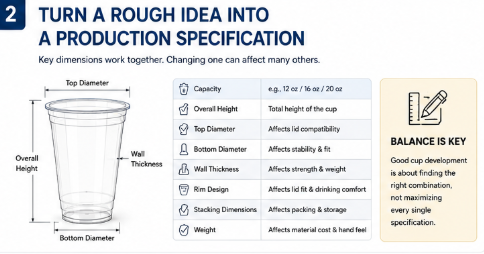
Before tooling, however, the idea needs to become a measurable specification. Capacity, overall height, top diameter, bottom diameter, wall thickness, weight, rim design, and stacking dimensions all need to be considered.
For a custom plastic cup supplier, these details are much more useful than a request such as “make it similar to this photo.”
The measurements also cannot be treated independently. Making the cup taller changes more than its appearance. A wider opening can affect the lid. A thinner wall can lower material use but may make the cup feel too soft. A different taper can change how many cups can be stacked together.
Good cup development is therefore about finding a workable combination rather than maximizing every individual specification.
Pick the Material Based on the Job

Material selection is another decision that should follow the application.
PET is often considered when clear product presentation is important. PP may be more suitable when the cup needs a different balance of rigidity, flexibility, or temperature performance. Other materials may be considered when the product has specific environmental or application requirements.
A plastic cups manufacturer for foodservice packaging should be able to explain what changes when one material is replaced by another, rather than simply quoting a material name and price.
Cup weight matters here as well. Two cups made from the same material can perform quite differently because of their wall thickness and overall weight. Making a cup lighter may reduce the material bill, but there is a point where saving a few grams starts to affect how the cup feels and performs.
For a buyer, the useful comparison is therefore not just material price. It is the combination of material, weight, performance, production stability, and expected order volume.
Decide Whether an Existing Mold Is Enough
Not every custom project needs a brand-new mold.
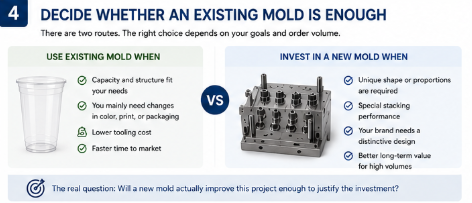
If an existing cup already has the right capacity and basic structure, the buyer may only need a different color, printed artwork, or packaging. This can be a sensible way to launch a new product without taking on unnecessary tooling costs.
A dedicated mold becomes more reasonable when the cup needs a particular shape, unusual proportions, special stacking behavior, or a design that competitors do not already use.
An experienced OEM plastic cup factory should be willing to discuss both routes.
For a new brand testing demand, using an existing structure can keep the initial investment under control. A restaurant chain expecting regular high-volume orders may have a different calculation. The additional tooling cost can be spread over a much larger number of cups, while the brand gets a product designed around its own requirements.
The important question is not “Can you make a new mold?” It is “Will a new mold actually improve this project enough to justify the investment?”
Check the Design Before the Mold Is Made
A cup can look excellent in a drawing and still be awkward to manufacture.
This is where a proper design review earns its value.
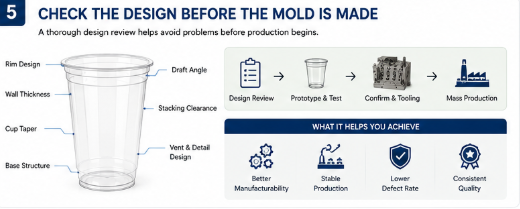
The factory should look at the wall thickness, cup taper, rim, base, draft, stacking clearance, and other structural details before the mold is produced. The aim is not to change the appearance for the sake of manufacturing convenience. It is to catch problems while they are still inexpensive to fix.
For an ODM plastic cup manufacturer, this stage can be particularly important because the factory may be helping develop the product rather than simply producing an existing design.
A small change to the rim or wall structure before tooling may take little effort. Discovering the same problem after a mold has been completed is a very different situation.
Design the Lid With the Cup, Not After It
The lid deserves attention much earlier than many buyers expect.
A cup may have the correct capacity and attractive shape, yet the final packaging can still fail because the lid does not fit properly.
The opening diameter, rim shape, sealing area, lid material, straw hole, and stacking arrangement all need to work together. A loose lid can cause spills. An overly tight fit can make the package difficult to use.
This is why a custom plastic cup supplier for takeaway businesses should evaluate the cup and lid as a complete set when the application requires both.
It is much easier to solve compatibility problems during development than after thousands of cups have already been produced.
Use the Sample as a Real Product Test
A sample should not be approved simply because it looks good.
Put the actual drink inside it. Use the intended lid. Stack several cups. Handle them as they would be handled in a restaurant or distribution center.
Look at the things that matter in everyday use: Does the cup feel rigid enough? Does the lid stay in place? Is the rim comfortable? Does the printed artwork sit correctly on the curved surface? Can the cups be separated easily after stacking?
If the cups will be exposed to unusual temperatures, those conditions should also be included in testing.
Once the sample has been approved, keeping it as a reference is useful for future orders. A plastic cup factory for wholesale orders can then compare later production against an agreed standard instead of relying on vague descriptions such as “same as last time.”
Plan Printing Before Production Starts
Printing is part of the product design, especially when the cup is being used as a branding tool.
A small logo on a clear cup is relatively straightforward. Full-surface artwork, multiple colors, or printing around a tapered cup requires more planning.
The shape of the cup affects how artwork sits on the surface. A design that looks perfectly balanced on a computer can appear stretched or uneven after printing.
Buyers working with a custom plastic cups manufacturer for private label packaging should therefore confirm the printable area and artwork requirements before the cup structure is finalized.
This avoids having a finished mold that works perfectly from a manufacturing perspective but leaves too little usable space for the brand's packaging design.
Look Beyond the Unit Price
Custom cup quotations can be misleading when buyers compare only the price per piece.
The actual quotation may reflect the cup weight, material, mold, printing, packaging, order quantity, production efficiency, and other project requirements.
For example, a heavier cup may cost more per piece but provide a noticeably better feel. A cheaper supplier may also have a lower quoted price while using packaging that increases damage during transport.
A plastic cups supplier for large-volume buyers should therefore be evaluated on the complete offer rather than one number on a quotation sheet.
For repeat orders, consistency can be worth more than a small difference in unit price. A cup that stays within the agreed dimensions and appearance from one production run to the next makes inventory planning much easier.
Choose the Factory Before You Finalize the Project
The right manufacturer should be able to participate in the project before production begins.
Ask how they handle design review, mold development, sampling, material selection, printing, lid matching, inspection, and repeat orders. If the answers are vague, problems may appear later when something needs to be changed.
A capable OEM plastic cups supplier for restaurant chains should also be comfortable working from practical information rather than waiting for the buyer to solve every technical detail.
Before requesting a quotation, provide the intended capacity, reference design or dimensions, material preference, color, printing requirements, lid requirements, estimated quantity, packaging needs, and destination market whenever possible.
That gives the factory enough information to discuss the project realistically.
A successful custom plastic cup is rarely the result of one clever manufacturing step. It usually comes from getting a series of small decisions right before production begins.
Start with the application, turn the idea into clear specifications, choose the material carefully, decide whether new tooling is worthwhile, test the cup with its actual lid, and approve a sample that represents what you really want to receive.
Once those pieces are settled, mass production becomes much more predictable—and the cup you receive by the truckload is far more likely to be the same cup you originally had in mind.