An acai bowl can look perfect when it leaves the kitchen and still arrive at the customer’s door in poor condition. The base may have started melting, the fruit may have shifted, and the granola that was crisp at the counter may already be soft.
That is the problem restaurants need to solve when turning an acai bowl into a takeout product.
Making an acai bowl for delivery is not simply a matter of preparing the same recipe and putting it into a container. The recipe, toppings, bowl size, lid, assembly process, and expected delivery time all need to work together. For businesses serving a large number of orders, working with a custom acai bowl manufacturer can also make it easier to match the packaging with the actual product rather than forcing the product into an unsuitable container.
Start With the Takeout Conditions
Before changing the recipe or buying new packaging, consider how long the bowl normally spends between preparation and consumption.
A customer picking up an acai bowl five minutes after preparation has very different requirements from someone receiving it after a 30- or 40-minute delivery. A short-distance order may work well with a standard bowl and securely fitted lid. Longer deliveries require more attention to melting, condensation, topping movement, and moisture transfer.
The selling format matters as well. A premium smoothie shop may want the bowl to look attractive immediately after opening, while a high-volume restaurant may place more emphasis on fast assembly and packaging cost.
This is why an acai bowl supplier for restaurant chains needs to understand more than the bowl’s capacity. The packaging has to fit the operation behind the product.
Build an Acai Base That Can Handle Delivery
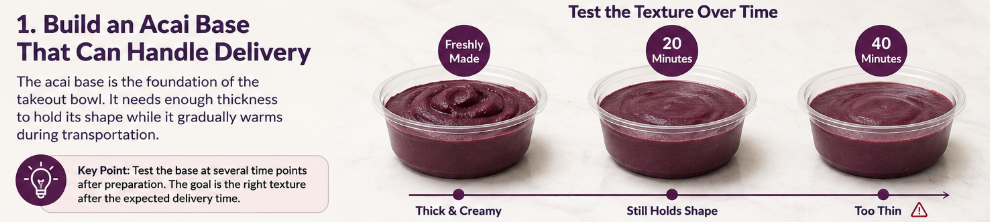
The acai base is the foundation of the entire takeout bowl. If it is already too soft when assembled, there is little the packaging can do to fix the problem later.
A base intended for delivery generally needs enough thickness to hold its shape while it gradually warms. Adding too much liquid during blending can make the mixture easier to process, but it can also leave the finished bowl thin and watery after a period of transportation.
The target should not be the hardest possible frozen texture either. A customer still needs to be able to eat the bowl soon after receiving it.
The useful question is therefore not, “What is the perfect acai recipe?” It is, “What texture does the product need to have after the expected delivery time?”
Restaurants can test the base at several time points after preparation. If it becomes noticeably thinner after 20 or 30 minutes, the recipe and serving temperature may need adjustment before the packaging is blamed.
For businesses developing their own branded products, an OEM acai bowl factory can also work with specific dimensions and packaging structures that suit different serving sizes.
Choose Toppings for the Journey, Not Just the Photo

Fresh fruit looks excellent on a newly prepared acai bowl, but not every topping performs equally well during transportation.
Some fruits release more liquid after cutting. That moisture can spread into the base or reach granola and other crunchy ingredients. Softer fruit can also move when the container is tilted during delivery.
The solution is not to remove fresh fruit from the product. Instead, the topping arrangement should take delivery conditions into account.
Fruit that holds its shape well can usually be placed directly on the bowl. More delicate ingredients may need to be positioned carefully or added closer to dispatch. Sauces and nut butters also need attention because they can spread across the surface as the bowl moves.
A wholesale acai bowl manufacturer should therefore be evaluated on more than price and appearance. Container depth, opening size, and lid clearance can directly affect how toppings perform after the order leaves the store.
Keep Granola Crunchy
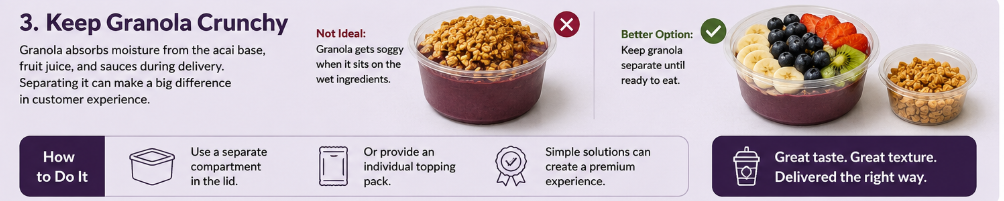
Granola is one of the easiest parts of an acai bowl to get wrong during takeout.
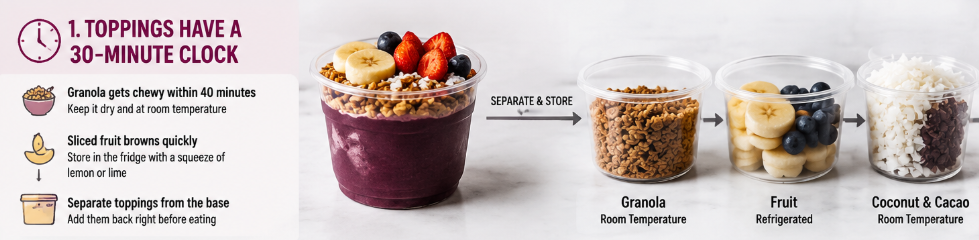
Inside the restaurant, it may remain crisp because the customer eats the bowl immediately. During delivery, however, granola can sit against the cold, wet surface of the acai base for 20 or 30 minutes. Fruit juice and sauces create another source of moisture.
For short delivery times, placing granola on top may be perfectly acceptable. For longer routes, separating it from the wet ingredients can produce a noticeably better customer experience.
This does not always mean using complicated packaging. A small separate compartment or individual topping pack may be enough, depending on the product price and delivery distance.
For brands selling premium bowls, an acai bowl packaging supplier for foodservice brands can help develop a packaging setup that keeps crunchy toppings separate without making the overall package unnecessarily complicated.
Match the Bowl Size to the Actual Serving
Choosing a container by volume alone can create problems.
A bowl that technically holds the required amount may be too shallow for a generous topping arrangement. A container that is much larger than necessary can make the product look undersized while increasing packaging and storage costs.
Depth is particularly important for acai bowls. There needs to be enough space for the base and toppings without forcing the lid directly onto the fruit.
The shape also affects the customer's first impression. A clear, well-proportioned container allows the colors and layers of the product to remain visible, which can matter when customers decide what to order from an online menu.
A custom acai bowl supplier can be useful when standard food containers do not provide the right combination of capacity, depth, and presentation.
The Lid Needs to Protect the Toppings
The lid is part of the product experience, not just a cover.
A secure fit helps prevent leakage as the frozen base begins to soften. At the same time, the lid needs enough clearance to avoid pressing against fruit, granola, or decorative toppings.
A flat lid can work well when the toppings stay below the rim. A dome-style lid may provide additional headspace for bowls with a higher topping profile.
Condensation is another detail worth testing. A cold product placed in a warm delivery environment can create moisture inside the package. While some condensation is unavoidable, poor container and lid combinations can make the bowl look less appealing when opened.
A reliable acai bowl packaging manufacturer for takeout businesses should therefore be able to discuss lid fit and structural performance rather than focusing only on the bowl itself.
Design the Bowl for Movement
A takeout bowl should be designed around what happens after it leaves the kitchen.
During delivery, the container may be placed in a bag, moved onto a scooter or bicycle, tilted around corners, and stacked with other orders. Even a short trip can change the appearance of a carefully arranged bowl.
This makes topping placement important. Ingredients should not depend on a delicate arrangement that collapses after a few minutes of movement.
The bowl also needs enough structural stability to resist deformation when handled or stacked. For businesses shipping large quantities, these details become even more important because a packaging problem that affects one order can become a recurring customer complaint across hundreds of orders.
Test the Bowl at 15, 30, and 45 Minutes
Before launching a takeout acai bowl, run a simple real-world test.
Prepare the product exactly as it would be during normal service. Close the final packaging, place it inside the usual delivery bag, and leave it for the expected delivery period.
At around 15 minutes, check the appearance and texture. At 30 minutes, look for melting, liquid separation, topping movement, and changes in granola texture. If the business accepts longer-distance orders, repeat the test at around 45 minutes.
The important point is to test the complete system rather than one component. A good recipe can still fail with the wrong container. A strong container cannot compensate for an overly watery base.
This type of testing is particularly useful when working with an ODM acai bowl factory, because packaging dimensions and structure can be adjusted according to the results instead of being selected only from a standard catalog.
Balance Takeout Performance With Packaging Cost
The most expensive packaging solution is not automatically the best one.
A low-priced acai bowl sold within a short delivery radius may not need separate topping containers or specialized lids. A premium product delivered across a larger area may justify the additional packaging because the customer experience has a direct connection with the product's perceived value.
Labor also matters. If a packaging design takes significantly longer to assemble, the added material cost is only part of the equation.
The right setup should balance product quality, delivery time, packaging cost, storage requirements, and assembly speed. For high-volume operations, a bulk acai bowl packaging factory can also become an important partner for maintaining consistent supply once the packaging format has been tested and approved.
Build the Bowl Around the Delivery Experience
A successful takeout acai bowl is not defined by how it looks at the moment it leaves the kitchen. It is defined by how much of that experience remains when the customer opens the container.
For short-distance orders, a thick acai base, fresh toppings, crunchy granola, and a secure clear bowl may be enough. Longer deliveries may require more attention to topping separation, lid clearance, moisture control, and container stability.
The best approach is to treat the recipe and packaging as one system. Test the product under real delivery conditions, identify where quality starts to decline, and then adjust the base, toppings, container, or lid accordingly.
For restaurants, meal-prep brands, and foodservice distributors, this approach also makes supplier selection more practical. Instead of simply searching for the cheapest acai bowl supplier, buyers can look for a packaging partner capable of supporting the actual serving size, delivery conditions, and production volume of the business.