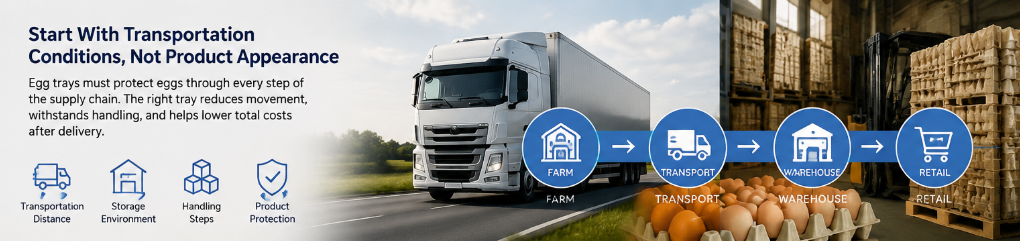
A customer receives a shipment of eggs and finds several cracked shells. The cartons are still in reasonable condition, with no obvious signs of crushing. After checking the packing process, the problem turns out to be less obvious: some eggs have moved out of their original positions during delivery.
This situation is frustrating for egg packers and distributors because the trays may have performed perfectly well during filling and warehouse storage. The trouble only becomes apparent after the shipment has travelled over uneven roads, passed through several handling stages, or spent hours inside a delivery vehicle.
In many cases, replacing the tray with a thicker version is not the first thing to do. The more useful question is where the movement begins. An egg may be loose inside its compartment, or the entire tray may be sliding around inside the shipping carton. These problems need different adjustments.
Start by Checking Where the Movement Happens

Take a loaded tray and look at the eggs before considering any changes to the packaging. Are the eggs sitting firmly in their individual pockets, or can some of them lean noticeably when the tray is moved?
Pay particular attention to smaller eggs. A compartment that holds larger eggs reasonably well may leave too much clearance when used for a smaller batch. During vehicle movement, those eggs can rock inside the pockets and gradually change position.
Now check the tray itself. If the loaded tray can slide from side to side inside the carton, the issue may have little to do with the individual compartments. The carton could simply be too large for the tray arrangement.
This distinction matters when working with a custom egg tray manufacturer. Before requesting a new mold, buyers should establish whether the problem comes from the egg pockets, the tray dimensions, or the outer packaging.
A Compartment That Looks Large Enough May Still Be the Wrong Size
Eggs are not perfectly identical, even when they belong to the same commercial size category. Some are wider, others are longer, and occasional differences in shape can affect how they sit inside a tray.
Imagine a packing operation handling a batch with noticeable size variation. The largest eggs fit comfortably, but the smaller ones have room to tilt. A compartment designed around the largest sample may therefore be unsuitable for the entire batch.
Making the pockets smaller is not necessarily the answer. If the opening becomes too tight, workers may struggle to load eggs quickly, and larger eggs may experience unnecessary contact around the compartment edges.
The depth of each pocket deserves the same attention. A shallow compartment may leave too much of the egg exposed, allowing it to lean when the tray is shaken. A deeper pocket can improve positioning, provided the egg can still be loaded and removed without difficulty.
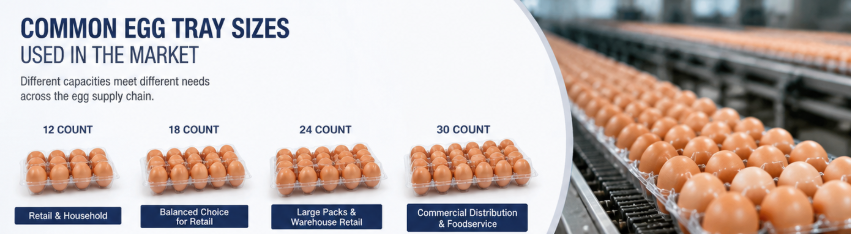
For an OEM egg tray supplier, receiving actual egg measurements is more useful than receiving a request for a standard 30-egg tray. The number of compartments tells very little about whether the tray will suit a particular packing operation.

Look Closely at the Dividers Between Eggs
One detail worth checking on a physical sample is the height and shape of the walls separating adjacent compartments.
When an egg leans, the divider helps prevent it from moving directly into the neighboring pocket. If the walls are too low, or the spacing is poorly designed, two eggs may approach each other as the tray moves.
The bottom of each pocket matters too. Eggs should rest in a stable position rather than balance on a small contact area. A poorly shaped supporting surface can allow repeated rocking, even when the surrounding walls appear sufficiently high.
Buyers comparing plastic egg tray manufacturers should therefore look beyond the number of pockets and the overall appearance of the product. Turn the tray over, inspect the compartment profile, and place eggs into several positions, including those near the edges and corners.
The edge compartments are worth checking separately. They do not always experience the same support conditions as eggs positioned in the middle of the tray.
Check the Space Between the Tray and the Shipping Carton
Here is a problem that can easily be missed during product selection.
A tray fits inside a carton, so the packaging team assumes the dimensions are correct. However, fitting inside a box does not mean the tray is properly secured. If there is too much room around the loaded trays, the complete stack may move whenever the vehicle turns or brakes.
This is particularly relevant when customers change carton suppliers or switch to a different shipping box without checking the internal dimensions.
The vertical arrangement also needs attention. If several trays are stacked together, the upper layers should remain properly aligned. A poor fit between layers can allow them to shift, while excessive compression may deform the dividers and change the space available around each egg.
A bulk egg tray manufacturer should understand how its trays will be packed, not just how they look when displayed individually. Buyers should provide the actual carton dimensions and intended stacking arrangement when requesting samples.
For existing packaging lines, an egg tray supplier for commercial distributors should also check whether a proposed replacement tray can work with the customer's current cartons.
Test the Loaded Tray Before Approving a Large Order

An empty tray can look perfectly stable. Once eggs are added and several layers are stacked, the situation may change.
A useful sample check starts with the actual eggs that will be packed. Load a complete tray, move it gently in different directions, and observe whether individual eggs rock or tilt. Repeat the check with smaller and larger eggs from the intended batch.
Next, stack the trays as they would be arranged for delivery. Look for gaps between layers, movement around the edges, and any changes in the shape of the compartments under load.
If the shipment travels over long distances, a more representative vibration test is worthwhile. Testing the complete carton is especially important because it reveals whether the trays remain in position during repeated movement.
Do not judge the result only by the number of broken eggs. Check their positions before and after testing as well. Eggs may shift without immediately cracking, and that movement can indicate a packaging problem that deserves attention.
An ODM egg tray factory should be prepared to discuss sample adjustments when the first design does not fit the customer's requirements. Changing the pocket dimensions or modifying the tray arrangement may be more useful than simply increasing the material thickness.
What Information Should You Give the Supplier?
When requesting samples, avoid sending only a picture of an existing tray and asking for something similar. Two trays can look almost identical while having different compartment dimensions and stacking characteristics.
A better starting point is to provide the egg size range, the number of eggs per tray, and the internal dimensions of the shipping carton. Explain how many layers are normally stacked and whether the products travel locally or through longer distribution routes.
If possible, send several actual eggs along with the sample request. This allows the egg tray manufacturer for wholesale packaging to check the fit rather than relying entirely on measurements.
For buyers replacing an existing product, it is also helpful to explain what went wrong with the previous design. Was there too much movement inside the pockets? Did the trays slide inside the carton? Did the dividers deform after stacking?
These details give the supplier a much clearer direction when adjusting the design. A professional egg tray supplier for export shipments should be able to evaluate the tray together with the customer's packing conditions before the order moves into mass production.
The Tray and the Carton Need to Work Together
Preventing eggs from shifting during delivery is not simply a matter of making the tray stronger. A compartment that is too large, a divider that provides insufficient separation, or an oversized shipping carton can each contribute to the same problem.
The best place to start is with the actual eggs and the way they are packed. Check how they sit in the compartments, how the trays fit together, and whether the loaded packaging remains stable inside the carton.
A tray that performs well under these conditions is much more useful than one that only looks sturdy on a product specification sheet. For distributors and egg packers, getting this combination right can help reduce avoidable damage and make deliveries more consistent.