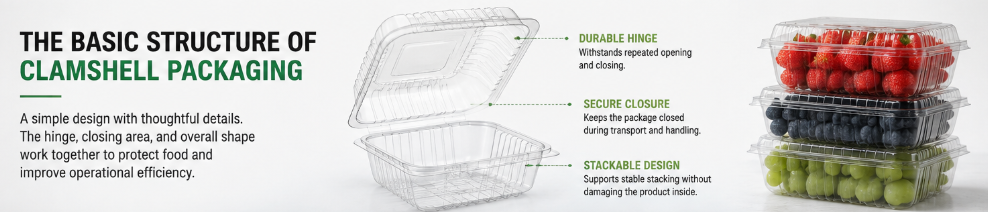
A takeaway order arrives with the lid partly open. The food is still inside, but sauce has spilled onto the other items in the bag. The restaurant has to deal with an unhappy customer, and the packaging becomes an obvious suspect.
Before switching to another clamshell container, find out when the lid started to open. A box that never closed properly needs a different fix from one that came loose after being stacked in a delivery bag. Treating both problems the same can lead to higher packaging costs without solving the issue.
Start With the Container That Failed

Keep a few failed containers instead of throwing them away immediately. Check the front latch, the side edges, and the hinge area. One side may have separated while the rest of the lid remains closed. That small detail can help narrow down the cause.
Next, pack the same food into another container of the same size. If the lid rises as soon as the food is added, check the space between the meal and the lid. Burgers with tall toppings and generously filled takeaway meals can put continuous pressure on the closure.
If the empty container also struggles to close, look more closely at the fit between the lid and base. A clamshell packaging supplier for restaurant groups should be able to use these observations to investigate the actual problem rather than immediately recommending a more expensive product.
Check the Fit Before Increasing Material Thickness

A container does not need to feel unusually thick to stay closed. What matters is whether the closure engages properly and remains engaged during normal use.
Try several containers from the same carton. Do they close with similar pressure? Does the latch click into place, or does one side spring back? Notice whether the rim sits evenly around the base.
If the results vary between samples, ask the supplier to examine the moulded closure features and dimensional consistency. If every sample has the same weakness, the design itself may need attention.
A custom clamshell container manufacturer may be able to adjust the depth, latch geometry, or other structural features. The appropriate change depends on the failure observed. Adding material without correcting a poorly matched latch may increase cost while leaving the original problem untouched.
Reproduce the Way Orders Are Delivered

Some containers close perfectly on the packing counter and open only after they have been placed in a delivery bag. This is where testing an empty box becomes misleading.
Use the normal meal, packing arrangement, and delivery bag. Place the containers in the same positions staff use during service. Check whether a heavier box presses against the lid below it, or whether the sides are squeezed by a tightly packed bag.
Repeat the test with fewer containers stacked together. If the problem disappears, investigate the load and stacking arrangement before changing the entire packaging specification.
Hot food deserves a separate check. Steam, condensation, and food movement may affect different designs in different ways, but none should automatically be blamed without evidence.
A food packaging factory for takeaway businesses should be able to discuss the conditions the container needs to withstand. Ask for samples suited to the actual application, not simply a box that looks sturdier.
Compare Samples Using the Same Meal
When testing a replacement, keep the conditions consistent. Use the same food portion, close the lid in the same way, and reproduce the usual stacking and transport arrangement.
Record which containers open and at what stage. A lid that releases during packing points toward a different issue from one that opens only after the bag has been moved.
For a restaurant group, these records can also help identify whether the problem is limited to one container size or affects several products. A clamshell packaging manufacturer for foodservice distributors can then review the results and recommend a more targeted change.
Agree on acceptance criteria before approving a bulk order. These should reflect the intended food load and normal delivery conditions. There is little value in approving a sample based only on how easily it closes when empty.
Give the Supplier Something Specific to Investigate
When reporting a recurring issue, include the affected product, batch details, photographs, and a description of how the lid opened. If possible, return an actual failed sample.
Ask the supplier to check the closure fit, possible deformation, and variation between production samples. If a design modification is suggested, request revised samples and repeat the original test. A verbal assurance that the new version is stronger is not a substitute for checking its performance.
For private-label products, a private label clamshell packaging supplier should also explain whether the proposed change affects tooling costs, lead times, or the price per unit. Buyers ordering several sizes should confirm that each approved specification is documented separately.
This is especially important for repeat orders. A sample approved months ago is useful only if subsequent production continues to meet the agreed requirements.
Decide Whether to Adjust or Replace the Container
Not every opening problem requires new packaging. If food is pressing against the lid, a different depth or a revised packing method may be sufficient. If the closure repeatedly releases under ordinary handling, a different structural design may be necessary.
Compare alternatives on more than purchase price. Consider how reliably the lid stays closed, how easily staff can pack orders, and whether the container suits the food being sold. A small saving per unit can disappear quickly when staff must repackage meals or replace damaged orders.
A clamshell container supplier for commercial kitchens should be able to provide samples and explain the intended use of each design. For large-volume purchasing, an OEM clamshell packaging manufacturer may also help assess whether a specification change is practical for ongoing production.
The key is to fix the failure you can demonstrate, not the one you assume is happening. Once the cause has been identified and a revised container has passed realistic delivery tests, the purchasing decision becomes much easier to justify.