Greaseproof paper is useful, but it is not always the best answer for every food packaging application. A bakery may need better release performance in the oven. A takeaway business may be dealing with hot, oily food that needs more structure. A supermarket may care more about product visibility and shelf presentation than simply keeping grease from soaking through the package.
That is why replacing greaseproof paper should not start with the question, “Which paper is similar to it?” A better question is: What problem is the current packaging failing to solve?
Once that is clear, the right alternative can be much easier to identify.
Why Are Businesses Looking for Alternatives to Greaseproof Paper?
For many food businesses, grease is only part of the problem. A sheet of paper may handle a relatively dry bakery product well but become less suitable when the food contains oil, moisture, heat, and sauces at the same time.
For example, fried food can release both oil and steam after packing. A sandwich may sit inside its packaging for an hour before delivery. A freshly baked product may still be warm when it is packaged. In these situations, simply choosing a “more grease-resistant” paper may not solve the entire packaging problem.
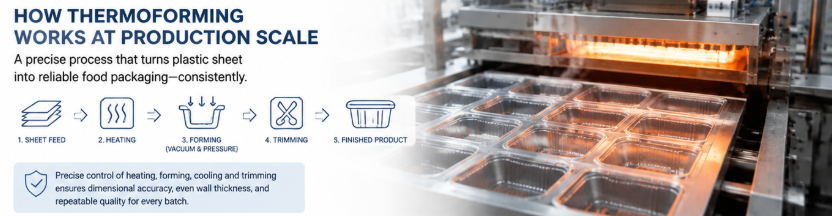
Cost and operational efficiency can also become important as a business grows. A small bakery may be comfortable cutting and folding sheets manually. A food manufacturer shipping thousands of portions every day may prefer a formed tray, bowl, or container that can be filled and sealed more consistently.
This is where working with a custom greaseproof paper manufacturer for commercial food packaging can help when a paper format is still appropriate, but it is also worth considering whether paper is actually the right format anymore.
Start With the Food, Not the Material

Before choosing an alternative, look at what the package needs to handle.
Is the food hot when packed? Does it contain oil or sauce? Will it be transported for several hours? Does it need to be reheated? Is the package mainly for foodservice, delivery, or supermarket display?
These questions matter because grease resistance and leakage resistance are not the same thing.
A paper that prevents oil from quickly soaking through may still struggle with liquid sauces. Likewise, a material that works well with cold food may not maintain the same performance with hot food.
For buyers working with a greaseproof paper supplier for wholesale food packaging, these application details are more useful than simply asking for the “best” greaseproof paper alternative.
What Can You Use Instead of Greaseproof Paper?

Coated Paper for Flexible Food Packaging
If you like the flexibility and familiar appearance of paper but need stronger barrier performance, coated paper can be a practical starting point.
It can work well for sandwiches, bakery products, wraps, and other foods where the package needs to remain lightweight and flexible. The important question is not simply whether the paper is coated, but what the coating is designed to withstand.
For a coated greaseproof paper alternative manufacturer serving foodservice distributors, the useful specifications will usually relate to the actual application: grease exposure, moisture, temperature, food-contact requirements, and converting process.
Parchment or Baking Paper for Oven Applications
If the real problem is food sticking during baking, parchment or baking paper may make more sense than standard greaseproof paper.
This is particularly relevant for cookies, pastries, bread, and other baked products. The key difference is the job the material needs to perform. Packaging a finished product and lining a baking tray are not necessarily the same application.
A greaseproof paper factory for bakery and foodservice applications should therefore be able to distinguish between baking, wrapping, lining, and serving requirements rather than treating them as one packaging category.
Silicone-Coated Paper for Release Performance
For applications where non-stick or release performance is especially important, silicone-coated paper can be another option.
This can be useful in baking because the material is designed around release performance rather than simply preventing grease penetration. However, it should not automatically be considered the universal replacement for greaseproof paper.
If the package also needs moisture resistance, structural protection, or long-distance transportation performance, another format may be more suitable.
When Paper Is No Longer the Best Solution

Sometimes the problem is not the type of paper. It is the fact that a thin sheet of paper is being asked to perform a job better handled by a formed package.
PET for Visibility and Retail Presentation
PET packaging becomes attractive when the product needs to be protected while remaining visible.
For bakery products, fresh foods, snacks, and retail-ready applications, a clear container can provide a different combination of protection, presentation, and handling compared with a paper sheet.
For buyers moving beyond paper, an OEM greaseproof paper packaging supplier offering PET food containers may be worth considering because the replacement may involve changing the packaging format rather than simply changing the material.
PP for Hot and Prepared Foods
PP can be a better fit when heat handling and structural strength are major concerns.
Prepared meals, noodles, hot takeaway foods, and other products can benefit from a rigid container rather than flexible paper. The exact suitability still depends on the specific PP grade, container design, temperature, and intended use.
A PP and greaseproof paper packaging manufacturer for takeaway food brands can therefore help compare the two approaches based on the actual food application rather than treating them as direct material substitutes.
Sugarcane Bagasse for Fiber-Based Foodservice Packaging
For businesses looking for a fiber-based alternative with more structure than a thin sheet, sugarcane bagasse packaging can be another route.
It can make sense for takeaway meals, catering, and foodservice applications where the buyer wants a formed disposable package instead of flexible paper.
However, “fiber-based” does not automatically mean that the package will perform perfectly with every oily or wet food. Actual food testing remains important.
This is why an ODM greaseproof paper replacement factory for sustainable foodservice packaging should ideally evaluate the complete packaging application, not just provide a material name.
Don't Choose an Alternative Based on Material Alone

One of the easiest mistakes is assuming that two packages made from the same material will perform identically.
Thickness, coating, geometry, sealing, ventilation, and forming quality can all change the final result. Food temperature and contact time matter as well.
A thin paper wrap and a rigid PP container are solving very different packaging problems, even if both are marketed for greasy food.
For this reason, a greaseproof paper replacement supplier for private-label food packaging should be able to discuss the finished packaging structure, not just the raw material.
Test Before You Place a Bulk Order

A sample should be tested with the food it is actually going to package.
Pack the real product at the normal serving or filling temperature. Then check what happens immediately and after the expected holding period. Look for oil penetration, softening, deformation, leakage, condensation, and loss of structural strength.
If the product will be delivered, simulate that environment too. Stacking, movement, temperature changes, and transportation time can expose problems that are invisible during a five-minute sample test.
This is especially important when evaluating a greaseproof paper alternative manufacturer for bulk food packaging, because laboratory specifications alone cannot always predict how a package will behave in a real distribution process.
When Should You Switch to a Different Packaging Format?
If your current greaseproof paper works well, remains economical, and fits your production process, there may be no reason to replace it.
But if the recurring problem is leakage, weak structure, difficult handling, poor retail presentation, or inefficient packing, searching for another type of paper may only delay the real solution.
The better approach may be to move from a sheet to a tray, bowl, clamshell, or other formed package. In that situation, the goal is no longer to find a paper that behaves exactly like the old one. The goal is to find a packaging system that performs better for the food, production process, and distribution conditions.
For wholesale and private-label projects, a greaseproof paper packaging factory for OEM food packaging programs can also help evaluate whether the existing paper format should be improved or replaced altogether.
Ultimately, the best greaseproof paper alternative is not necessarily the material with the most impressive specifications. It is the option that solves the actual problem without creating a new one somewhere else in the supply chain.