Start Here If You've Never Built One
Skewers. If this is your first time and the event matters, make fruit skewers instead of a platter. They hold their shape for hours, nothing pools at the bottom, guests don't touch each other's food, and a sloppy assembly job still looks deliberate on a tray. A flat arranged platter is prettier in photos and far less forgiving in real life. Everything below is about choosing between the two honestly, based on how much time you have and how long the food has to sit.
Rank Ideas by Survival, Not by How They Photograph
The useful way to sort fruit tray ideas isn't by theme. It's by how long each one lasts on a table at room temperature.
Skewers and individual cups sit at the top; both will still look fine at the two-hour mark, and cups are what corporate and school events keep landing on for hygiene reasons anyway. A rainbow arch is easy to assemble and reads beautifully in pictures, but the strawberry row starts weeping around the forty-minute mark. Number and letter platters for milestone birthdays hold their edges only if you build them on a firm base of melon and grape rather than berries. A carved watermelon basket is the showpiece everyone wants and the one I'd talk most people out of, because it takes real knife skill and it fills with liquid from the inside. Cheese-and-fruit boards look expensive and taste great, though the cheese absorbs moisture and goes gummy within the hour if the fruit isn't drained first. Holiday shapes, Christmas trees and pumpkins and flower bouquets, are all high-risk, high-reward. Grazing displays are the most impressive and the most labor.
Cheapest three: watermelon-heavy platters, grape and melon skewers, and simple seasonal bowls. Most photogenic three: rainbow arch, bouquet, grazing spread. Most reliable three: skewers, cups, ice-bed platters.
The Puddle Problem and How to Kill It
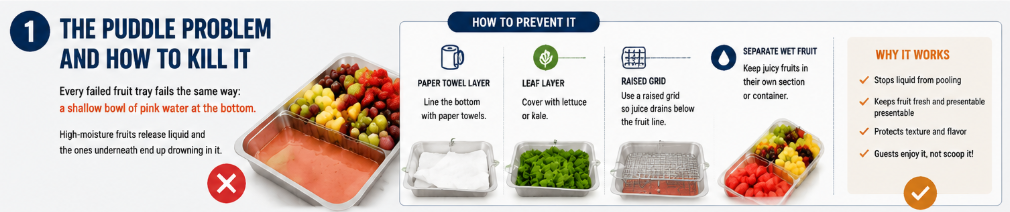
Every failed fruit tray fails the same way: a shallow bowl of pink water at the bottom by the time guests arrive. The cause is that watermelon, strawberries, orange segments and pineapple all release liquid steadily, and the fruit underneath drowns in it.
Build in a drain. Line the bottom of the platter with a paper towel layer, then leaf lettuce or kale as a visual cover, and set the high-moisture fruit on that. Better yet, use a container with a raised grid insert so juice collects below the fruit line. Better still, keep the wet fruit in its own section entirely and never stack it under anything. Caterers who deal with this weekly stop improvising and order vented or double-wall containers from a custom fruit tray manufacturer rather than reusing whatever came from the supermarket, because a two-inch drainage gap fixes the problem permanently and costs almost nothing at volume.
Apples Go Brown in Fifteen Minutes
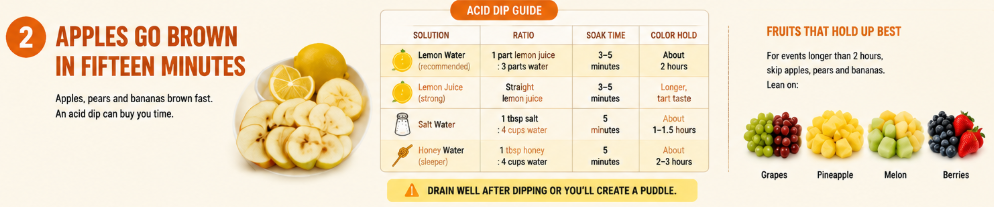
Faster than that, in warm rooms. Bananas are worse and shouldn't be on a tray that sits, full stop. Pears brown almost as fast as apples.
An acid dip works, but you need to know for how long. Lemon juice diluted about one part to three parts water, a brief soak of three to five minutes, then drain well, buys you roughly two hours of acceptable color. Straight lemon juice buys longer and tastes sharp. Salt water works and leaves a taste most people notice. Honey water is the sleeper option, holds well and tastes fine. Whatever you use, drain hard afterward or you've just solved browning by creating a puddle. If your event runs longer than two hours, skip apples and pears entirely and lean on grapes, pineapple, melon and berries.
How Much to Actually Buy
The mistake isn't portion size, it's yield. Half a pineapple ends up in the bin. A whole watermelon gives you far less usable flesh than its weight suggests, cantaloupe loses roughly half, and grapes and blueberries lose essentially nothing.
Plan around three quarters of a cup of prepared fruit per guest when fruit is one item among several, and a full cup when it's a main snack. For fifty people, that means shopping for something in the neighborhood of two pineapples, four pounds of grapes, half a large watermelon, two pounds of strawberries, two cantaloupes and a pound of blueberries. Write your list in units you can hand to a cashier, not in pounds of finished product. Buy what's in season and swap by color and firmness rather than by name, so a peak-season honeydew replaces an overpriced kiwi without wrecking the look.
Containers That Don't Sag, and Getting There in One Piece
A sixteen-inch round platter comfortably serves twenty to twenty-five, an eighteen-inch handles thirty-plus, and a paper plate will soften and bow under wet fruit inside an hour. Rigid is worth the money.
Transport is where home setups fall apart. Don't build the arrangement at home and drive it. Cut and store components in separate lidded boxes, then assemble on site in ten minutes. It genuinely looks better, because nothing has shifted. Operations doing this repeatedly usually standardize their packaging through a wholesale fruit tray factory or an OEM fruit tray supplier for event caterers, since matching lid depth to fruit height is what stops sliding in the car. If you run the same three menus over and over, a private label fruit tray producer working with catering distributors can size compartments to your actual recipes, and an ODM fruit tray production partner can tool inserts for skewers so they arrive standing up instead of lying in juice.
Outdoors in August
Assume forty minutes, not two hours. Heat accelerates everything, and wasps find cut melon within minutes.
Set your platter into a larger tray of ice so the base stays cold, keep it in shade rather than under a canopy that traps heat, and put out half your fruit while the rest waits in a cooler. Cover with mesh domes if bugs are likely. Skewers again win here, because guests grab and leave rather than hovering with tongs. For large summer programs, a bulk fruit tray vendor serving hospitality buyers is often the practical route to ice-bed and domed sets, and procurement teams comparing quotes should ask any fruit platter supplier offering factory-direct pricing on volume orders for depth and vent specs, not just diameter.
Your Timeline
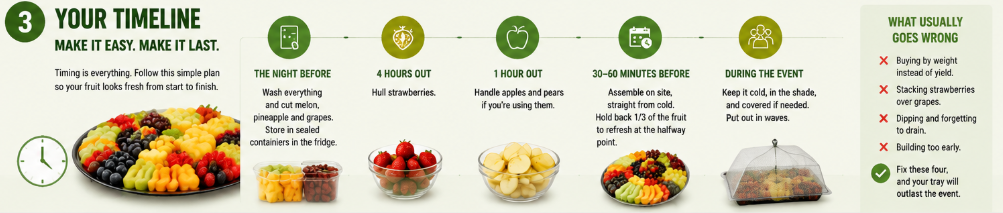
The night before, wash everything and cut melon, pineapple and grapes; all three hold fine refrigerated in sealed containers. Four hours out, hull strawberries. One hour out, handle apples and pears if you're using them at all. Assemble on site, thirty to sixty minutes before guests arrive, straight from cold. Hold back a third of the fruit to refresh the tray at the halfway point, because a topped-up platter looks intentional and a picked-over one looks abandoned.
What Usually Goes Wrong
People buy by weight instead of yield and end up short. They stack strawberries over grapes. They dip apples and forget to drain them. They build the whole thing at nine in the morning for a two o'clock party. Fix those four and your tray will outlast the event, which is the only measure that matters once the photos are taken.