A customer orders 10,000 chicken egg cartons every month. Then the business starts selling quail eggs. At first, using the existing cartons seems like a reasonable way to avoid developing another package. After all, both products are eggs, and both need individual protection.
But the first trial shipment raises a few questions. Why are the eggs moving around inside the compartments? Why is so much space left unused? And why does a carton that looks acceptable on the packing table become less practical when arranged in shipping boxes?
These are not unusual problems for egg producers expanding their product range. Quail eggs need a different packaging arrangement, not simply a smaller version of the carton already in use.
The Problem Starts When Quail Eggs Go Into a Chicken Egg Carton

Try placing several quail eggs into a conventional chicken egg carton. The difference is immediately visible. The eggs occupy only part of each compartment, leaving considerable room around them.
That extra space is not necessarily harmless. During handling, the eggs can move away from their original positions. Putting two or more eggs into one compartment might seem like a way to use the available space, but it also removes the separation that individual compartments are supposed to provide.
This is why some producers eventually move away from standard chicken egg cartons. A custom quail egg tray manufacturer needs to work from the dimensions of the actual eggs, including their size variation, rather than simply scaling down an existing carton.
There is another detail worth checking: the shape of the compartment. A quail egg should sit naturally in its designated position. If workers have to adjust every egg by hand, the packaging may become an inconvenience on a busy packing line.
A Carton That Works at the Factory May Not Work During Delivery

Packing and transportation are two different situations.
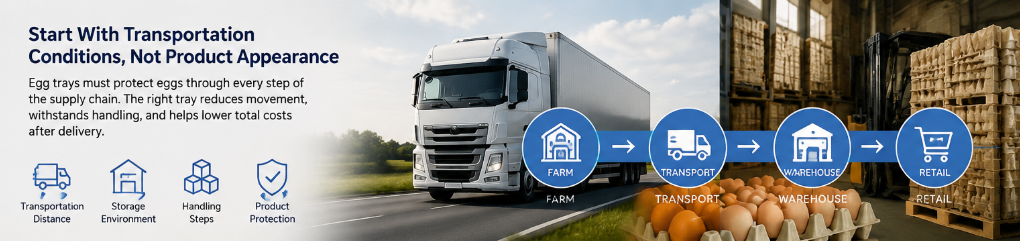
At the factory, workers can place eggs carefully and close each carton without much movement. Once the products leave the facility, however, they may be loaded onto pallets, transferred between vehicles, stacked in warehouses, and handled by retailers.
A loose compartment can become a problem during these stages. Eggs may shift, neighboring eggs may come into contact, and poorly designed lids may allow unwanted movement.
The solution is not necessarily to make every compartment deeper or every wall thicker. Excessive material and unnecessary dimensions can increase packaging costs without solving the actual problem.
Instead, filled cartons need to be tested. Check whether the eggs remain positioned after the carton is tilted, whether the lid touches the eggs, and whether the structure changes under stacking pressure.
For an OEM quail egg carton supplier, these practical checks are more useful than approving a design from an empty sample alone.
Selling 12 Eggs and Selling 24 Eggs Are Different Packaging Jobs
The number of eggs in a carton often determines how the package will be used.
A small retail pack is expected to fit comfortably on a shelf and allow customers to open it without difficulty. A larger pack may be purchased by restaurants, food distributors, or households that consume quail eggs regularly.
Consider a producer offering both 12-egg and 24-egg packs. Using the same basic carton footprint might simplify inventory, but it is not always the best arrangement. The internal layout, lid dimensions, and outer packaging may need to change.
The decision should also account for how the products are sold. A retailer may care about visibility and convenient access, while a distributor may be more concerned with the number of cartons that fit into one shipping case.
A custom quail egg packaging manufacturer for retail brands should understand these differences before recommending a mold. Otherwise, the finished carton may satisfy the egg count but fail to suit the actual sales format.
The Shipping Box Deserves as Much Attention as the Egg Tray
One issue buyers sometimes overlook is the relationship between the individual carton and the master shipping box.
A well-designed egg tray can still produce an inefficient shipping arrangement. If the finished cartons are too wide, too tall, or difficult to stack, valuable space may be lost between packages.
For businesses shipping thousands of cartons, this is worth investigating before production begins.
Take the proposed carton dimensions and arrange several filled samples in an outer box. Check how many fit without forcing them into position. Then examine whether the arrangement remains stable when multiple boxes are stacked.
A quail egg tray factory for bulk packaging orders should be able to provide accurate product dimensions and samples for this kind of evaluation.
It is also worth comparing the total shipping volume rather than focusing only on the price of one tray. A small difference in carton dimensions can become significant when multiplied across a large order.
PET and PP Should Be Chosen for the Selling Environment

Material discussions often become unnecessarily complicated. For most buyers, the starting point is much simpler: where will the eggs be displayed, and what does the packaging need to withstand?
PET is often considered for retail cartons because its transparency allows customers to see the eggs without opening the package. This can be useful when appearance and product inspection influence purchasing decisions.
PP is another option when buyers need a plastic structure with suitable rigidity. Its performance depends on the specific design and material thickness, so samples should be evaluated before selecting it for production.
An OEM PET quail egg packaging supplier may be a suitable partner for projects prioritizing clear retail presentation. Buyers considering PP should pay particular attention to the rigidity of the finished carton and its performance during stacking.
There is no reason to assume that one material will suit every quail egg business. Storage conditions, food-contact compliance, recycling requirements, and the intended sales channel all affect the decision.
What Should Be Confirmed Before the First Production Order?
The most expensive mistake is not necessarily choosing the wrong material. It can be approving a carton that has never been tested with the eggs it is supposed to hold.
Before confirming a custom order, send representative egg samples to the packaging supplier. If the eggs vary noticeably in size, provide samples from different batches. This helps identify whether the compartments are too loose for smaller eggs or too restrictive for larger ones.
The trial should also involve the people who will actually use the packaging. Can workers load the eggs quickly? Does the lid close without pressing against them? Can retailers open the carton without disturbing the remaining eggs?
These questions matter because a package that looks good in a product photograph may not work efficiently in daily production.
When comparing custom egg tray suppliers for wholesale buyers, ask for a physical sample, mold specifications, minimum order quantity, and production lead time. Also confirm whether the approved sample will be used as the reference for mass production.
For projects requiring a new carton structure, an ODM quail egg carton manufacturer may help develop the compartment arrangement around the buyer's preferred pack quantity and retail requirements.
A Different Product Line Calls for a Different Packaging Decision
Using chicken egg cartons for quail eggs may work for a small trial, but it should not automatically become the long-term packaging solution.
The real differences become apparent when products are packed in volume. Egg positioning, compartment dimensions, carton quantities, and shipping arrangements all affect how practical the packaging is.
For a producer planning regular quail egg sales, working with a quail egg packaging manufacturer for commercial distributors to test a dedicated design is often a more sensible starting point than repeatedly adjusting an unsuitable standard carton.
The important thing is to test the package with real eggs, in the quantities and conditions in which it will actually be sold and transported.