Greaseproof paper is produced through a series of papermaking operations that control fiber structure, sheet density, moisture content, and surface properties. Unlike ordinary paper, it must resist the penetration of oil without relying solely on a conventional plastic barrier.
The exact manufacturing route depends on the paper grade. Traditional greaseproof paper develops its resistance mainly through fiber processing and sheet formation, while other grease-resistant papers may use additional surface treatments or coatings. Understanding these differences is essential when selecting equipment and controlling production.
1. Raw Material Selection and Pulp Preparation

The process starts with selecting suitable cellulose pulp. Fiber characteristics influence the strength, formation, and final structure of the paper, so the raw material must match the intended product specification.
A greaseproof paper manufacturer for food packaging typically begins by preparing the pulp in water to create a uniform suspension. The pulp is mixed and cleaned to remove contaminants that could cause defects during production. Consistent pulp preparation also helps maintain stable operating conditions in the following stages.
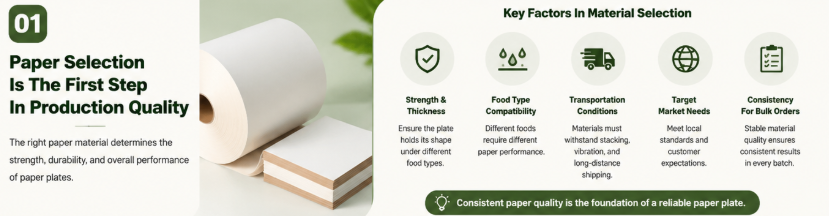
At this point, manufacturers establish the basic properties required for the finished paper, including basis weight, strength, and the intended level of grease resistance.
2. Pulp Refining: Developing Grease Resistance
Refining is one of the most important stages in traditional greaseproof papermaking. Mechanical action changes the surface characteristics of the fibers, helping them bond more closely when the paper sheet forms.
As the fiber network becomes more consolidated, the pathways through which oil can penetrate are reduced. However, refining must be controlled carefully. Excessive refining can slow drainage, increase energy consumption, and reduce production efficiency.
A greaseproof paper factory for industrial food wrapping therefore needs to balance fiber development with machine performance. The appropriate refining conditions depend on the pulp, target paper grade, and equipment configuration rather than one universal setting.
3. Sheet Formation and Water Removal

After refining, the pulp suspension enters the paper machine's forming section. Water drains through the forming fabric while the fibers gradually create a continuous sheet.
Uniform formation is critical. If fiber distribution varies across the sheet, the finished paper may contain areas with different density or strength. These variations can affect grease resistance and lead to inconsistent results during subsequent processing.
The forming stage also influences paper thickness and basis weight. Manufacturers monitor these properties to keep the sheet within the required specification.
For a bulk greaseproof paper manufacturer for foodservice packaging, stable sheet formation helps reduce defects and maintain consistency throughout long production runs.
4. Pressing and Drying
Once the initial sheet has formed, it passes through pressing and drying operations. Mechanical pressing removes additional water and consolidates the sheet, while the drying section reduces moisture to the level required for finishing and conversion.
Drying conditions must be controlled because uneven moisture removal can contribute to curling, dimensional changes, or handling problems. The objective is to produce paper with stable physical properties, not simply to remove water as quickly as possible.
A greaseproof paper roll supplier for packaging converters also needs to consider how moisture and sheet stability affect the finished rolls. Paper that is difficult to handle can create problems during slitting, printing, or automated packaging.
5. Surface Treatment and Finishing

Not every greaseproof paper requires a separate coating stage. In traditional grades, grease resistance is developed primarily through the paper structure. Other grades may receive surface treatments or coatings when additional barrier properties are needed.
These treatments must be compatible with the intended application. Depending on the formulation, they may influence oil resistance, water resistance, printability, folding behavior, and recyclability.
A custom greaseproof paper manufacturer for bakery packaging should select the finishing route according to the required performance rather than assume that every product needs an additional coating.
After treatment, the paper may undergo finishing operations to achieve the specified surface characteristics, thickness, and appearance. The material is then prepared for downstream conversion.
6. Slitting, Rewinding, and Sheet Cutting
Once the paper has reached its required properties, it is converted into the formats specified by the customer. Large parent rolls may be slit into narrower rolls, rewound to the required diameter, or cut into individual sheets.
Slitting accuracy, edge quality, and winding tension all affect the usability of the finished product. Poorly wound rolls may telescope or develop uneven edges, while inaccurate cutting can create waste during packaging operations.
An OEM greaseproof paper supplier for food packaging brands should control these conversion parameters alongside the paper's physical specifications. A consistent base paper can still create production problems if the final roll or sheet dimensions are incorrect.
7. Quality Control During Manufacturing
Quality control should take place throughout production rather than only after the paper has been converted. Manufacturers commonly monitor basis weight, thickness, moisture content, strength, and visible defects. Grease resistance must also be evaluated using a test method appropriate for the specific paper construction.
TAPPI T 559 is associated with the Kit Test, but its scope must be considered before applying it to different barrier systems. Where necessary, manufacturers should supplement laboratory testing with application-specific trials.
For a wholesale greaseproof paper manufacturer supplying food packaging distributors, consistent test conditions and documented production records help identify deviations between batches. Food-contact compliance must be verified separately because a grease-resistance result alone does not establish that a material is suitable for direct food contact.
Conclusion
Greaseproof paper manufacturing begins with pulp preparation and refining, followed by sheet formation, pressing, drying, and finishing. The paper is then slit or cut to the required dimensions and inspected against its specifications.
Each stage contributes to the final result. Fiber processing and sheet formation establish the paper structure, drying affects stability, and finishing and converting determine whether the material meets the requirements of its intended format. Controlling these operations together is what enables manufacturers to produce greaseproof paper with consistent performance and reliable quality.