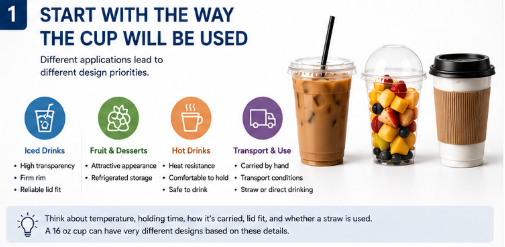
A customer orders 500 dessert cups for a weekend promotion. The cups are filled, decorated, and packed without any obvious problems. A few hours later, some arrive with cream around the edges. The lids are still attached, but the packaging no longer looks clean.
This is a frustrating problem for dessert businesses because the cause is not always easy to identify. The cup may be fine, the lid may look like the correct size, and yet the two do not work well together once the product is filled and moved.
When sourcing custom dessert cups from a packaging manufacturer, the first thing to check is not the advertised capacity. It is the actual fit between the lid and the cup rim.
Why A Lid Can Stay On And Still Allow Cream To Escape

There is a difference between a lid that stays attached and one that closes properly around the entire rim.
Take a cup where the lid clicks into place on three sides but remains slightly raised near the fourth. During packing, this may go unnoticed. Once the cups are placed in a delivery bag or stacked inside a carton, pressure can act on that weak section. Cream may then reach the edge and leave a visible mark.
The cup itself can be responsible, too. A slightly uneven rim or variations between production batches may prevent the lid from sitting consistently. In other cases, the problem starts before the lid is applied. Cream left on the rim during filling creates an obstruction between the two surfaces.
These situations can look almost identical when a customer reports a leaking cup. However, they need different solutions. Tightening the lid will not correct an uneven rim, and changing the cup will not help much if staff are repeatedly filling it too close to the top.
For plastic dessert cup suppliers, this distinction is important when investigating complaints. A returned sample showing cream around the edge is more useful when accompanied by information about filling level, closure method, and transport conditions.
Do Not Choose A Lid Just Because The Diameter Matches

Capacity and diameter are convenient figures in a product catalogue, but they do not tell the whole story.
A 200 ml dessert cup from one manufacturer may have a rounded rim, while another uses a slightly different edge profile. Their lids may have similar external dimensions, yet the inner locking structures are not necessarily interchangeable.
A suitable snap-on lid needs to engage with the cup edge around its circumference. When closed, it should not have one section sitting higher than the rest. Nor should workers have to press excessively hard at certain points to make it stay in place.
There is another practical issue during daily packing. If a lid is too difficult to apply, workers may spend extra time pressing around the edge or accidentally deform the cup. If it is too loose, normal handling can cause it to shift.
This is why OEM dessert cup manufacturers should supply the matching lid rather than asking buyers to select one from a list of supposedly compatible sizes. The actual cup and lid need to be checked together.
For a business purchasing several cup sizes, it is also worth keeping separate records of the approved lid model for each cup. Similar-looking products are not a reliable substitute.
The Filling May Be Causing The Problem

A common mistake is to test the cup with a low filling level and then use it for a much fuller dessert.
Imagine a mousse cup with a layer of cream, fruit, and a piped topping. The product may fit comfortably inside the container before decoration. After the topping is added, however, there may be very little clearance between the dessert and the lid.
When the lid is pressed down, the topping can be flattened and cream pushed toward the rim. Some of it may enter the closure area. The cup can appear sealed initially, but the material around the edge makes the fit less dependable.
For custom PET dessert cups for bakeries, sample approval should use the finished product, not just the base filling. This is particularly relevant to whipped cream desserts, layered mousse, tiramisu portions, and products with fruit decorations.
There is no single headspace measurement suitable for every dessert. A flat mousse surface and a tall cream topping have different packaging requirements. The useful measurement is the clearance needed by the actual product while still allowing the lid to close without touching or squeezing the filling.
What To Check Before Approving A Sample
A sample that fits when empty is only the beginning. Before placing a large order, fill several cups using the normal recipe and have them closed by the people who will actually pack the products.
Pay attention to the closure process. Does the lid settle evenly with ordinary hand pressure? Does one side need repeated pressing? Is cream being pushed onto the rim? These small observations often reveal more than a quick visual inspection of the finished cup.
After closure, move the samples through the normal packing process. Put them into the intended carrier or carton, stack them if this is part of the operation, and check them after handling. For products sold through delivery services, a short transport trial is particularly useful.
An inversion test can be included, but it should not be the only acceptance standard. Thick cream does not behave like water, and passing a brief upside-down test does not prove that the packaging will withstand a longer journey.
When dealing with dessert cup suppliers for commercial kitchens, ask whether the samples represent the actual production specifications. A carefully selected display sample is of limited value if the dimensions of the bulk order are not consistent with it.
Changing Suppliers Can Create An Unexpected Fit Problem
Businesses sometimes replace a packaging supplier because of price, availability, or minimum order quantities. The new cup may look almost identical to the old one, so the purchasing team assumes that the existing lids will still work.
That assumption can become expensive.
Even when the nominal diameter is the same, the rim profile and locking edge may differ. A replacement lid that appears suitable in a catalogue may be loose on the actual cup. The reverse can happen as well: a lid may require so much pressure that staff struggle to close it consistently.
If existing cup stock needs to be retained, send a physical sample to the new supplier. Ask for a lid that matches the existing rim and test it before ordering. For ODM disposable dessert cup factories, this may involve adjusting the lid design rather than replacing the entire cup specification.
Keep one approved cup-and-lid combination as a production reference. This is useful when repeat orders are placed or when a different production batch needs to be checked.
What Should Be Confirmed Before Bulk Production?
The purchase specification should identify the actual cup model and its matching lid, not simply describe them as a 250 ml cup with a standard cover.
Confirm the rim dimensions, lid structure, material, filling level, and intended use. If the product will carry whipped cream or be transported in stacked cartons, include those conditions in the sample approval process.
For wholesale dessert cups with fitted lids, repeatability matters. A lid that fits one sample perfectly but becomes loose across a later batch is still a purchasing problem.
An OEM plastic dessert cup factory for private-label brands should be able to provide a matched sample for approval before mass production. The approved combination should then serve as the reference for subsequent orders.
Ultimately, cream leakage is rarely solved by choosing a lid based on diameter alone. The more useful approach is to check how the lid engages with the rim, whether the finished dessert leaves enough clearance, and how the complete package behaves after handling. These are the details worth resolving before the first large shipment leaves the factory.