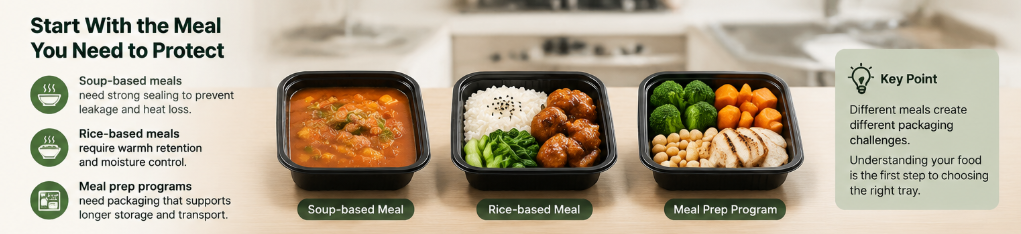
A compartment tray can do its job perfectly well in the kitchen and still disappoint the customer. This happens quite often with takeaway meals containing curry, gravy, dressings, or dipping sauces. Everything is placed in the right section before the lid goes on. After a drive across town, the sauce has found its way into the rice or vegetables.
For a restaurant, the immediate reaction might be to look for a container with taller dividers. That can help in some cases, but it is not always where the problem lies. A tray originally used for grilled chicken may start causing trouble when the menu changes to meals with more sauce. The packaging has stayed the same; the food has not.
Start With the Meal That Causes the Most Complaints

Rather than testing every container in the kitchen, look at the orders where food mixing happens most frequently.
A rice meal with curry is a good example. The rice takes up most of the main section, while the curry is placed in a smaller compartment. If the portion grows slightly during a busy shift, the sauce may sit almost level with the divider. A driver does not have to handle the bag particularly roughly for it to move across.
Salads present a different situation. A dressing that looks harmless in a small quantity can spread over several ingredients when the tray is tilted. The restaurant may then receive complaints that the vegetables have become soggy, even though the container has not leaked outside.
This is useful information to share with a custom compartment tray manufacturer. Instead of asking for a generic leak-resistant design, explain which menu item causes trouble and how much food normally goes into each section.
The Shape of the Compartments Matters More Than It First Appears

Two trays can have the same number of compartments and still behave very differently.
One may have a wide, shallow section for sauce. Another may provide a smaller but deeper space. The first gives staff more room to serve a large portion, while the second may be better at keeping liquid below the divider during ordinary handling.
The main food section matters too. If it is too small, employees may pile rice or meat higher than the surrounding walls. Once the lid is fitted, food can be pressed against the divider or moved into another section.
I would pay attention to the bottom connection of each divider as well. It should be properly formed and should not become distorted when the filled tray is lifted. A product photograph rarely tells buyers much about this detail.
When comparing a plastic compartment tray supplier's samples, put the same meal into each design. The difference in usable space is often more revealing than the dimensions printed on the catalogue.
Do Not Use One Sauce Arrangement for Every Menu Item

A restaurant selling several meal combinations may need more than one packaging arrangement.
Take soy sauce and barbecue sauce. A small amount of thick barbecue sauce can usually remain in a compartment without much movement. Thin soy sauce is less forgiving, particularly if it is placed near the top of a shallow section.
Curry and gravy need another consideration: portion size. A large serving may take up considerably more room than the restaurant originally expected. Making the divider higher does not necessarily solve the problem if the sauce section itself is too small.
For a custom PP compartment tray manufacturer, this is where the intended application becomes important. Buyers should provide details about the actual sauce volume and food arrangement before agreeing on a design.
There is little value in developing a tray around a small dressing portion if the restaurant plans to use it for a full serving of curry.
Is a Separate Sauce Cup Actually Worth the Extra Cost?
Some meals are simply easier to pack when the sauce is kept outside the tray.
Fried chicken with dipping sauce is an obvious example. Nobody wants the coating to become soft before the food arrives. A separate cup also gives customers the choice of adding as much sauce as they want.
For salads, keeping dressing separate can preserve the appearance of the ingredients during delivery. The same approach works for meals where a thin sauce would otherwise occupy too much of a compartment.
There is a downside. Staff have another container to fill, close, and place inside the order. The restaurant must also maintain additional packaging inventory. For a business processing large takeaway volumes, the extra handling time should be considered alongside the cost of the cup.
A wholesale compartment tray supplier should be able to discuss both arrangements. Sometimes a revised compartment design is enough; in other cases, using a separate sauce cup is the more sensible decision.
A Sample Should Be Tested on a Busy Kitchen Day
Testing a tray with water on an empty workbench tells you very little about how it will perform during service.
Use an actual menu item and let the kitchen pack it in the normal way. Do not ask employees to be unusually careful or reduce the portion just to make the sample look good. The point is to reproduce the conditions that caused the complaint in the first place.
Close the tray with its intended lid. Then place it in a delivery bag, carry it around, and stack it if that is part of the normal process. A moderate tilt is worth checking, especially for meals containing thin sauces.
When you open the sample, look at the whole meal rather than just the sauce compartment. Has the rice moved? Is there sauce on the vegetables? Does the lid touch the food? Has the tray bent after being carried?
These details help distinguish a structural problem from a filling problem. If the sauce only spills when a section is filled to the very top, changing the portion arrangement may be enough. If the divider deforms during handling, a different tray structure deserves consideration.
A custom food compartment tray supplier should be able to provide samples for this kind of evaluation. Keep a record of the food portions and the conditions used so that different designs can be compared fairly.
What Can Go Wrong After the Sample Is Approved?
There is another issue that often gets less attention during purchasing: the difference between an approved sample and a repeat production order.
A restaurant group may approve a tray after several rounds of testing, then place a much larger order for distribution across multiple locations. If the production specifications are not clearly established, the next batch may not perform exactly like the sample.
Buyers should confirm the tray dimensions, divider arrangement, material, and matching lid before production begins. Keeping an approved sample is also useful when checking later deliveries.
An OEM compartment tray manufacturer may support branding and agreed product specifications, while an ODM compartment tray factory may be more suitable when the existing layout needs to be redesigned.
For distributors, the issue is not limited to one restaurant's menu. Different customers may use the same tray for different foods, so consistent production and clearly defined specifications become particularly important. A disposable compartment tray supplier should understand these requirements before repeat orders are placed.
A tray does not need the tallest dividers or the largest number of sections to work well. What matters is whether the sauce has enough room, whether the food stays below the lid, and whether the packaging can handle the way orders are actually delivered. Those details are worth checking with a real meal before committing to a large quantity.